
Two years ago, just a couple weeks before the 2016 presidential election, I asked what does it look like when citizens don’t trust elections?
Perhaps more than anything that he has said through his campaign, Donald Trump’s charge that the upcoming presidential elections will be rigged have frightened political observers, and especially political scientists. The reason is that elite and public acceptance of electoral procedures is essential to democratic politics. Political scientists understand that the foundation of democratic political order is the acceptance of the rules of the game. The only way that we really know that losers accept those rules when they lose and respect the outcome. The politics of a losing presidential candidate rejecting the election itself is almost unimaginable. It would risk a crisis of systemic legitimacy.
But what would such politics look like, now that we must imagine it? American history is no great source of information. There is the case of the Civil War, which began when southern states seceded from the union. But this was a cleavage first and foremost over policy—slavery—and the political order that it required. And as such, the Civil War had a clear regional divide over that policy. Trump’s allegations about vote-rigging are not regionally defined, and they are not about specific policy. They are channeling mass dissatisfaction with the entire political system, refracted (as is often the case with Trump) through the candidate’s own self-obsessions. No state could, or would, secede from the union over Trump’s electoral defeat. The crisis of systemic legitimacy would be national, within the states, between supporters of Trump and his opponents.
The answers are not good, and I used the examples of Thailand and Madagascar to make my point. In the event, President Trump did not question the legitimacy of the 2016 election because he won it. But this morning, things have changed.
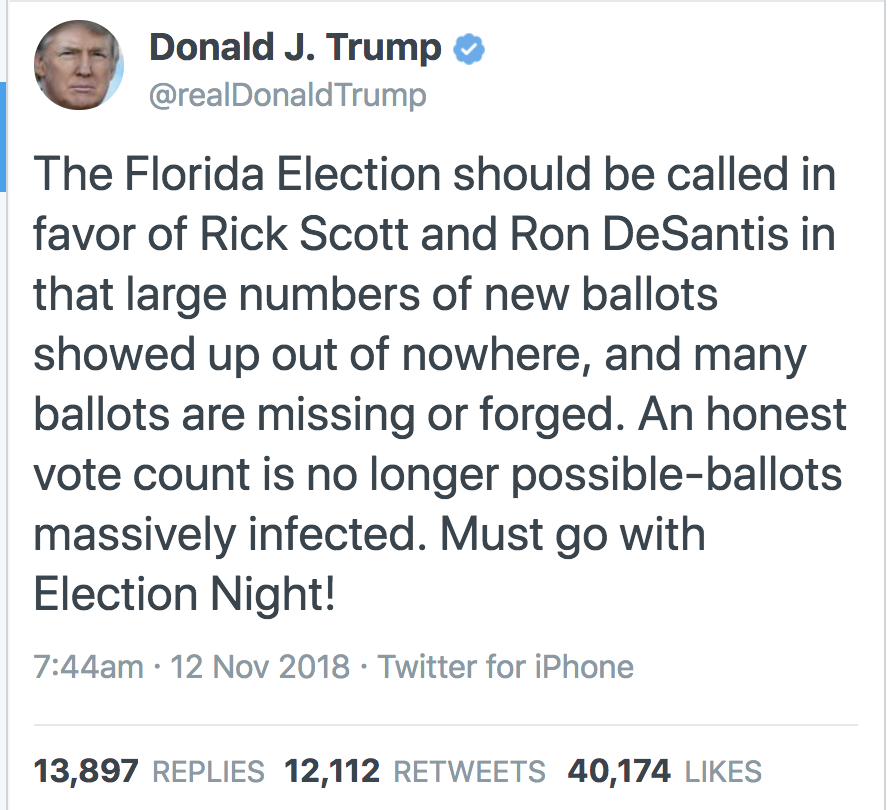
It is now the official White House position that constitutionally-mandated recounts are illegitimate.
In a month of harrowing news, this development is still almost incalculably bad for American democracy. I now assume that a substantial minority of Americans believe that the results of the elections in Florida, Georgia, Arizona, and California are democratically illegitimate unless the Republican candidate wins. Updating the lessons from the previous post,
- When electoral procedures lose popular legitimacy, it is nearly impossible to get that legitimacy back. Elections are one great way of building popular legitimacy, and if by assumption they no longer do, what will?
- Non-electoral sources of power are particularly dangerous when elections no longer legitimately empower politicians. It now falls to the very politicians who are involved in the recount to vouch for its legitimacy. The safest way to defend that legitimacy would be for the losing candidates to rebuke the President, directly and publicly. A public endorsement would be most meaningful if it were to come from, for example, DeSantis. Let us just ponder how likely that is.
- The downstream consequences from the loss of electoral legitimacy are nearly impossible to predict. I suspect that one consequence will be an ever-greater tolerance for executive malfeasance, on the logic that Congressional representatives and state governments lack democratic legitimacy.
Caveats, as always, apply.
Any number of Americans can tell you that they have never considered the current U.S. system to be legitimate. But even the strongest critics of electoral democracy must take seriously the gamble that they entertain when candidates like Trump undermine the legitimacy of U.S. elections. After all, look what happened when U.S. politicians tried to undermine the legitimacy of Obama’s presidency: Donald J. Trump became the GOP nominee.
 Tom Pepinsky
Comments
14 responses to “What Happens if Elections Are No Longer Legitimate?”
[…] Pepinsky of Cornell University, an expert on authoritarian politics, wrote with alarm Monday about he saw happening — and what the president is encouraging with his rhetoric about […]
[…] development is still almost incalculably bad for American democracy,” writes Tom Pepinsky, a professor at Cornell University who studies authoritarianism. “This is one of the most […]
[…] development is still almost incalculably bad for American democracy,” writes Tom Pepinsky, a professor at Cornell University who studies authoritarianism. “This is one of the most […]
[…] too many major media outlets amplified without correcting. Cornell University government professor Tom Pepinski wrote about the civic dangers of undermining confidence in elections, and No More Mister Nice Blog’s Steve M. noted that this continues a long-standing Republican […]
[…] development is still almost incalculably bad for American democracy,” writes Tom Pepinsky, a professor at Cornell University who studies authoritarianism. “This is one of the most […]
[…] procedures lose popular legitimacy, it is nearly impossible to get that legitimacy back,” argues Tom Pepinsky, a Cornell political scientist. “We’re in a dangerous place as a country,” says Brendan Nyhan […]
[…] When elections are no longer legitimate. The escalation in GOP conspiracy-mongering and the decision to have party leaders trumpet these […]
[…] procedures lose popular legitimacy, it is nearly impossible to get that legitimacy back,” argues Tom Pepinsky, a Cornell political scientist. “We’re in a dangerous place as a country,” says […]
[…] to secure victory for Republican candidates in both states. “In a month of harrowing news,” noted Cornell University political scientist Tom Pepinsky, an expert on authoritarian politics, “this […]
[…] secure victory for Republican candidates in both states. “In a month of harrowing news,â€? noted Cornell University political scientist Tom Pepinsky, an expert on authoritarian politics, […]
[…] Read the full story via TomPepinsky.com […]
[…] victory for Republican candidates in both states. “In a month of harrowing news,” noted Cornell University political scientist Tom Pepinsky, an expert on authoritarian politics, […]
[…] make it hard for future elections to be seen as legitimate, as Tom Pepinsky of Cornell University argued after some U.S. politicians called the midterm voting fraudulent. According to The Washington […]
[…] make it hard for future elections to be seen as legitimate, as Tom Pepinsky of Cornell University argued after some U.S. politicians called the midterm voting fraudulent. According to The Washington […]