Month: September 2012

  • Etymology of Coconut Oil Stew

    Every Indonesia hand knows about rendang, a spicy mutton or beef curry. What makes rendang so special is that it is prepared by boiling meat in coconut milk until the water of the coconut milk evaporates. When that happens, the coconut oil separates from the solids, and is used for frying the meat. Long-time readers will remember when we first made this dish in Jakarta in 2004.
    Rendang Daging, Taman Rasuna Apartments Flavor, 2004

    But maybe it’s not so special. It turns out that every good Jamaican knows about run dung (occasionally rundung or run-dung), also known as Dip and Fall Back, because

    When yuh boil down di coconut milk with seasoning to di point it turn custard and yuh add the salt fish – shad, cod or mackerel yuh haffi dip and fall back.

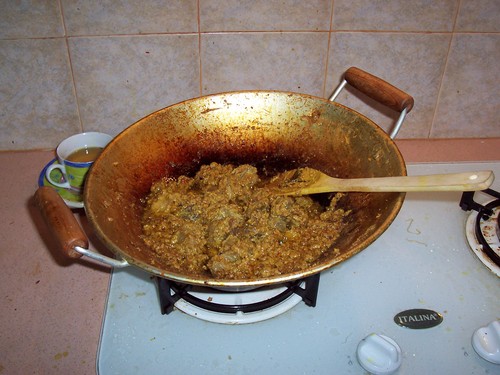
    This description seems to be exactly the same as making rendang. And run dung isn’t always made with fish. Check out this image of chicken run dung:

    Chicken in coconut “run dung” sauce, from http://www.bestjamaica.com

    The question to ask is how it got that way. Does rendang ≈ run dung? A brief web search cannot uncover an etymology for either term, but this is too close to be an accident.

    If the terms are related, it’s fun to speculate about the possible etymological links. Three paths seem possible to me.

    1. British encountered rendang either in Malaya or in the Netherlands Indies, and brought the recipe and the name with them to Jamaica. This isn’t as unlikely as it might seem: Sir Stamford Raffles was born in Jamaica, after all, and we all eat something called ketchup (= kecap).
    2. A related version of this: rendang came to the West Indies via the Javanese in Suriname—although rendang is Minangkabau in origins, I’m sure Javanese had heard of it—and from there made its way to the islands.
    3. Both run dung and rendang come from some Indo-Aryan or Dravidian root. It moved to Indonesia like many other words of those origins, through trade and cultural contact, and it moved to the West Indies through colonial migration. This is a story of common origins rather than later contact.

    If I were a PhD student in anthropology, I would work on topics like this.

  • Guess the Colonial Power

    As I polish up a first serious draft of a paper on decolonization, today I came across a discussion of “annexation.” I invite readers to peruse the following and imagine which tropical territory is being discussed.

    Many…who felt…that annexation was inevitable sentimentally opposed it. It would be far pleasanter, were the world constituted differently, for  many states, representing different planes of culture, different races, and differing attitudes toward life to exist beside one another in amity. But the world, simply, was not constituted that way.

    In the Nineteenth Century, as always before and always after, it was a realistic world, one whose separate parts continually came closer together. _____, potentially, had things that the world wanted. Left untroubled, the _____ans themselves clearly would not produce those things. Yet it could be fairly argued that they had no right to fail to do so. No one of radical opinions would grant the right of a private owner of great acres, of a factory, of a ‘means of production’ of any kind, to shut it off from common use merely because it was the owner’s whim or nature to do so. How then could it be argued that far greater proprietors under the name of race or nationality should exercise that right?

    Seems like something right out of the “enlightened” part of the colonial era, right? Say, mid-19th century on. Probably some Belgians talking about rubber in the Congo Free State. Or the British talking about rice in the Irrawaddy delta. The sentiment is not so much that the European should be enslaving the colonial subject, but rather that the colonial subject cannot be a proper member of the global economy without some direction. What is an enlightened European to do? (I love the use of the construction “it could be fairly argued” here.)

    Turns out, this quote is of more recent vintage, and it is not European. It is taken from John W. Vandercook’s 1939 book King Cane: The Story of Sugar in Hawaii (New York: Harper & Brothers Publishers), pp. 42-43. Yes, this is a quote is referring to the annexation of Hawaii, so that those noble yet indolent Hawaiians could be directed to grow sugar.

    Americans owe it to themselves not to forget this chapter of our history. For more, I highly recommend McCoy and Scarano’s Colonial Crucible on the role of empire in the construction of the modern American state.