Category: Politics

  • The Evolution of Indonesia’s Political Economy in One Amazing Figure

    My colleague Sharon Poczter and I are finishing up a new paper that analyzes the career backgrounds of a large sample of Indonesian political elites. This means cataloguing thousands of careers on elites’ CVs in order to classify them into various types, such as military, private sector, and so on. Because we have such a rich source of data, we can also analyze phenomena such as individuals with multiple types of employment over their lifetime; the predictive power of gender, religion, partisan affiliation, and education; and differences in career patterns over time.

    The last bit means exploiting differences in career histories based on elites’ ages (or implied ages for elites who have died). This is a crude form of cohort analysis, and it allows us to ask if older political elites tended to have different career paths than younger ones. We do this by fitting a series of logistic regression models predicting whether an individual has one of four types of backgrounds—private sector, bureaucracy, government, and military—using with a cubic polynomial of age as the main predictor alongside a series of demographic and political covariates. Here, we’ve plotted the predicted probability that an elite of a particular age has each of the four employment types. We’ve also included 95% confidence intervals. The result is striking.
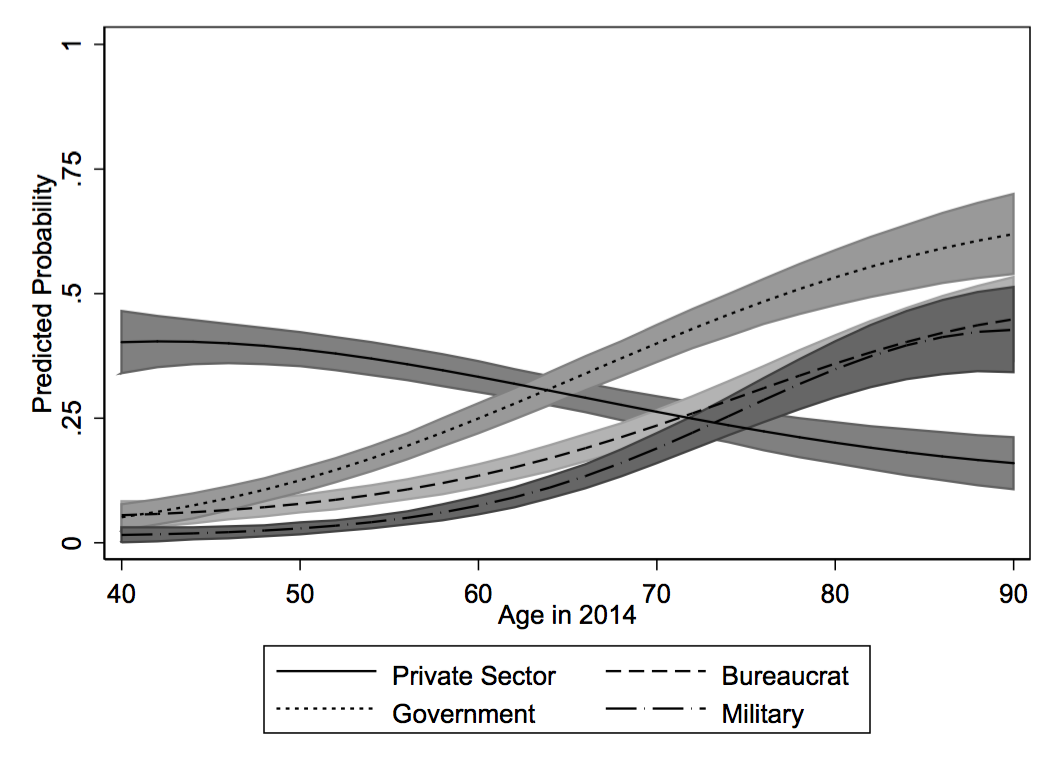
    margins

    Among older elites—those who rose to prominence under the New Order—military and bureaucratic backgrounds predominate. Among younger elites, who we can infer rose to prominence under the late New Order period or under democratic rule due to their age, private sector backgrounds predominate. This isn’t exactly the “Rise of Capital” that Richard Robison described: he considered the links between indigenous capital and the state to be much tighter than what this figure is describing, and I am not aware of his predicting a decline of military and state as avenues to political power alongside the rise of capital. But the findings are related, and they help to make sense of how Indonesia’s political economy has changed over the past fifty years.

  • Can Procedural and Substantive Democracy Move in Opposition Directions?

    It is possible for the electoral dimensions of democracy to become stronger at the same time that the substantive dimensions of democracy weaken or erode?

    Some background:

    1. Next Thursday, I’m participating in a Brown Bag discussion at Columbia with Joseph Liow, Duncan McCargo, and Ann Marie Murphy. Our collective task is to think about prospects for democratic backsliding and democratic progress in Southeast Asia. (Come on by!) My individual task is to do this in the context of Indonesia’s new Jokowi administration.

    2. Separately, I recently participated in a USAID-funded project on democratic backsliding. As part of that, I put together a short memo in which I tried to lay out a typology of varieties of democratic change. Borrowing the distinction between procedural versus substantive democracy, I produced this nine-fold typology of varieties of democratic change—assuming, of course, that this is change within a democracy rather than a discrete shift to authoritarianism.
    Screen Shot 2014-11-06 at 11.13.19 AM
    The typology is defined by possibilities of change. For example, if the latent probability that executive authority is allocated in competitive elections between political parties decreases (the procedural dimension), and rights and liberties are curtailed (a short-hand for the substantive dimension), then I want to call that “democratic degradation.” If rights remain the same but procedures corrode, I term that “authoritarian creep.”

    And as originally written, the typology had no term for 2 out of the 9 categories. Those are the combinations of “more procedure less substance” and “less procedure more substance.” At the time that I developed the typology, I hypothesized that those are not logically possible, what Colin Elman terms “logical compression.”

    But I am now reevaluating this in light of the new Jokowi administration. It strikes me that it’s entirely possible that Indonesia has become more procedurally democratic in the past year, but that we could nevertheless see further deterioration in the substantive dimensions of Indonesian democracy.

    But looking comparatively this would be rare, so my best guess is that it is possible, but not probable. As a hopelessly imperfect exercise, let’s just examine how frequently—in the cross-national context—we observe a decrease in civil liberties (as defined by Freedom House) alongside an increase in political rights (also defined by Freedom House). Here is a jittered scatterplot.
    PR vs CL
    Out of 6668 country-years around the world, we observe only 32 country-years (< 0.5%) where civil liberties decrease while political rights increase. But of course, if you don't share my evaluation that Indonesia's procedural democracy was strengthened over the past year, then you might consider deterioration in substantive democracy more likely (and in fact, 333 country-years around the world show civil liberties decreasing while political rights stay the same). But it's still relatively rare. But then again, it happened in Indonesia last year.

    In all, food for thought as we read the tea leaves of the new Jokowi administration, and as we conceptualize possible trajectories for Indonesian democracy over the coming years.