Category: Politics

  • Differences in Differences: The Gaza Withdrawal

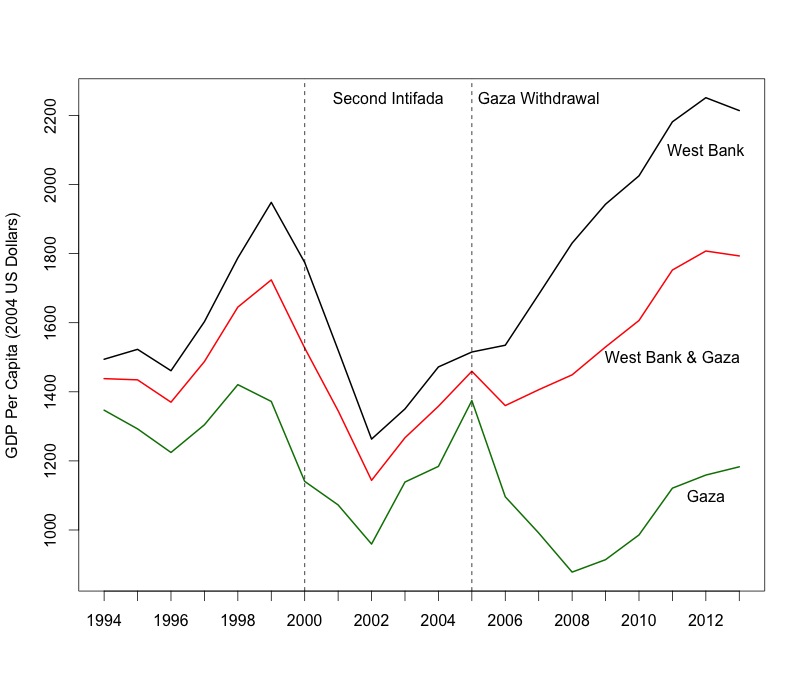
    I recently returned from an incredibly interesting visit to Israel and Palestine. Among the many interesting things that I had a chance to learn about was the stark difference between the West Bank (governed by Fatah) and the Gaza Strip (governed by Hamas). During one meeting in Ramallah, a presenter from the Palestinian Central Bureau of Statistics showed us this very illuminating figure comparing gross domestic product per capita in the West Bank and Gaza.

    10015006_10100884063581294_4178632248120555894_o

    This is blurry and hard to see (and written in Arabic), but the handy website of the CBS allows me to recreate it exactly using these data, with some additional annotations.
    Rplot

    Now we’re talking.

    Immediately apparent to all the social scientists in my group was the dramatic divergence in GDPPC trends after 2005. It has always been the case that Gaza is poorer than the West Bank, but Gazan living standards become much worse after 2005. A simple diff-in-diff analysis makes this point abundantly clear.

  • Call: lm(formula = GDPPC ~ Gaza * Withdrawal, data = dat.test)

  • Coefficients

    Estimate Std. Error t value Pr(>|t|)
    (Intercept) 1563.40 60.41 25.879 < 2e-16 ***
    Gaza -340.07 85.43 -3.981 0.000319 ***
    Withdrawal 345.19 90.06 3.833 0.000489 ***
    Gaza:Withdrawal -490.43 127.36 -3.851 0.000465 ***

  • — Signif. codes: 0 `***’ 0.001 `**’ 0.01 `*’ 0.05 `.’ 0.1 ` ‘ 1

    These results are consistent with at least two interpretations. The Fatah view—remember that we obtained the data from an official who almost certainly has links to Fatah—is that Fatah rules better than Hamas. An alternative view though, which some Israelis might support, is that the Israeli withdrawal is harmful for Palestinians. Because Israel is responsible for security and order in some of the populated areas of the West Bank, its presence ensures a more stable environment for economic activity than one would see without Israel, perhaps even in those places where the Palestinian authority does have full responsible for internal security and order. These data cannot adjudicate between these two interpretations. It might be interesting to see if Governorate-level data could do so by differentiating across areas of Israeli security presence.

    Something else that might not be so apparent, though, is that Gaza actually fared slightly better relative to the West Bank during the Second Intifada. Here is another simple diff-in-diff analysis.

  • Call: lm(formula = GDPPC ~ Gaza * Intifada, data = dat.test)

  • Coefficients

    Estimate Std. Error t value Pr(>|t|)
    (Intercept) 1819.93 57.39 31.710 < 2e-16 ***
    Gaza -656.39 81.17 -8.087 1.3e-09 ***
    Intifada -337.31 104.78 -3.219 0.00272 **
    Gaza:Intifada 318.76 148.19 2.151 0.03826 *

  • — Signif. codes: 0 `***’ 0.001 `**’ 0.01 `*’ 0.05 `.’ 0.1 ` ‘ 1

    If you look carefully you can see that the worst of the Intifada (2000-2) saw Gazan GDPPC fall less steeply than in the West Bank, and climb more rapidly in the latter phases. I’m not sure what to make of this, except for to observe that poorer places have less to lose under conditions of political and economic turmoil.

  • Muslim Democracy: Why Not Look to Indonesia?

    John Owen has a recent essay at the Monkey Cage entitled “What history says about the prospects for Islamic democracy.” It makes the case that democracy is entirely feasible in Muslim countries, but it may be unlikely in the near future.

    The West’s past suggest that, for a hybrid form of government to spread and flourish in a region, it must take hold in a large and influential country that interacts significantly with that region and is manifestly stable, secure and prosperous over time.

    Those large and influential countries for the West were Great Britain and the United States. Owen is skeptical that such a country exists right in the Muslim world. Not even Indonesia, the world’s most populous Muslim country and a consolidated democracy.

    Looking at the Middle East and its borderlands, it is difficult to find an exemplar of Islamic democracy. Indonesia, Malaysia and Bangladesh are all majority Muslim democracies, but their interactions with Middle Eastern states are too slight to qualify them as exemplars.

    I’m not sure how to parse Owen’s “interactions with Middle Eastern states are too slight.” A more pointed way to put it might be that Muslims in the Middle East don’t think that Indonesia counts.

    Stark, perhaps. Yet, it helps us to focus on what Owen is really dealing with in his essay. Owen is not writing about Islamic democracy, he is writing about Middle Eastern democracy. The elision of Middle Eastern political issues with the foundational questions of Islam’s compatibility with democracy is common, of course. But we must be sure that we realize it when we see it. And to remember that when it comes to Islam and democracy, yes, Indonesia counts.

    (For tangentially related writing on this topic, check out my recent essay “Political Islam and the Limits of the Indonesian Model” [PDF])