Category: Politics

  • What's Going in Indonesia and Malaysia Right Now?

    My mother-in-law asked JMP yesterday "so what's going on in Indonesia and Malaysia these days?" JMP cruised over to the Jakarta Post website and found this gem about 100 workers at an eyelash factory falling into a trance. So weird. I love that "the cause of the trance remained unclear."

    But seriously, what is new in Indonesia and Malaysia these days? Well, lots. Indonesia is gearing up for Obama's scheduled visit in a couple of weeks. The Democrat Party (the prez's party, which is really new but is trying to become more than just his personal vehicle) chose a new chairman. Former finance minister Sri Mulyani Indrawati starts her new job as a managing director at the World Bank on Tuesday. This is good for Indonesia's pride, but potentially a bad sign, as it seems that she was ousted from her MoF position by powerful businessman (and Indolaysia patron) Aburizal Bakrie for being too much of a reformer. The new Minister of Finance is Agus Martowardojo, whom I know little about except for that Bakrie hasn't liked him much in the past, so we'll see how that goes. He does have a pretty good reputation. Separate from that, something really surprising is that Indonesia just put a two-year moratorium on deforestation. That's an amazing commitment, although one that I suspect will be nearly impossible to enforce.

    In Malaysia, not quite so much. The background story is still that it's unclear how coherent the ruling coalition and the opposition coalition are. The ruling coalition has been looking a bit stronger as of late, but we would hardly know if they were about to fall apart. One interesting sign is that the horribly corrupt MIC President Samy Vellu is being challenged for the party leadership–thing is, he's resisted a number of challenges before, so I wouldn't be surprised if he withstood this one. Anwar Ibrahim's back on trial for allegedly sodomizing a young male aide. On the good side for the opposition, they did manage recently to win a by-election in Sarawak, where they have struggled to make inroads.

    How about in Singapore? Uh, well, ummmm. Hm. Oh yeah. Two Singaporean badminton players were suspended by the Singapore Badminton Association for having a bad attitude.
  • A Tale of Two Countries

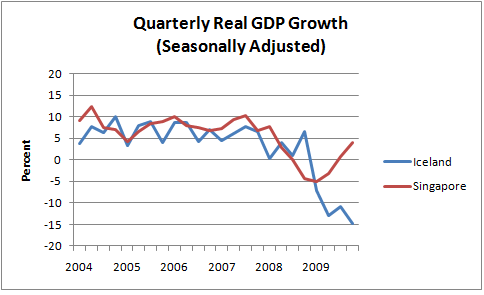
    Once upon a time there were two small island countries with really high standards of living, really boring politics, and highly open financial sectors. Each of them had a pretty concentrated banking sector (one of them had three domestic private banks, the other four) featuring stable banks that offered high rates of return on deposits and investments. Each had an open capital account (meaning that you can move money in and out of the country with no restrictions) and a stable but officially floating exchange rates. The barriers between politicians and banking sector elites were
    basically non-existent: politicians and bankers had close personal and business relationships. People from all over the region felt safe investing in these little island countries' assets, and around the world financial analysts praised them for their sound financial and macroeconomic policies. 

    In one of them (Country A), though, banks took advantage of what is known as the carry trade: they borrowed at low interest rates overseas, converted those loans into the local currency, then lent out at high interest rates at home. The difference (adjusted for the exchange rate) is pure profit for the banks. So long as the local economy kept going (and so long as they could keep getting those cheap loans overseas) that system would work just fine. Then one day the global economy had a little blip: the subprime mortgage crisis made lenders just a little less likely to lend. So the banks in Country A had to pull back a little on their lending at home to make sure they had cash to pay back their existing foreign debts. But when that happened, the local economy slowed down. Now, the banks found it harder to make back the money that they needed to pay back their loans. Now it wasn't about the carry trade anymore, it was just trying to stay above water. So they lent out a little less and kept borrowing abroad in the hope that the slowdown at home was temporary. It wasn't. The entire system quickly came to a halt, then fell apart. The currency collapsed. The economy collapsed. They had to call in the IMF, which everybody knows is a baaaad sign. The banks are gone, unemployment is through the roof, and the entire economy is left wondering where to go from here.

    In the other (Country B), banks decided not to do this. As a result, they chugged along happily during the crisis while financial institutions in Country A collapsed. The overall economy in Country B took a hit due to decreased demand for its exports elsewhere in the world, but it wasn't too bad. No one had to call the IMF. All the banks are still there. 

    If you haven't guessed yet, surprise! Country A is Iceland, Country B is Singapore. I would love to have some sort of answer to the obvious question: why did Singapore get it so right when Iceland got it so wrong? One answer is "regulation" but that's just restating the question: why did Icelandic regulators fail so miserably while Singaporean ones succeeded? And remember, both countries have (or if you're Iceland, had) really concentrated banking sectors that had all sorts of irregular links to politics worked closely with the political establishment. One answer is that banks in Singapore are all old family businesses, while banks in Iceland were new and naive. Another is that the bankers in Iceland were idiots and the bankers in Singapore are smart. I'm not sure, but I'd like to know.

    5-26-10