Category: Politics

  • First You Get the Sugar, then You get the Power

    Today’s revealing quote, from the Philippine-American Chamber of Commerce in NYC in 1930.

    There is no great aggregation of American capital in the Philippines like there is in Porto Rico, Hawaii, and in Cuba. To attack the sugars coming from those quarters would be to invite the hostility of powerful interests. The Philippines are weak and relatively defenseless, and therefore were singled out for attack.

    I found this in the Senate deliberations on Philippine independence in January 1930. “Single out for attack” here means “propose to grant independence to.” It’s so deliciously (ha!) revealing because it demonstrates a critical point about Philippine independence. It’s widely accepted that the U.S. sugar industry was instrumental in advocating for Philippine independence, but that doesn’t explain the whole story because you’d imagine that they’d advocate for the independence of PR and Hawaii too. They were key sugar producers too, with their own independence movements:
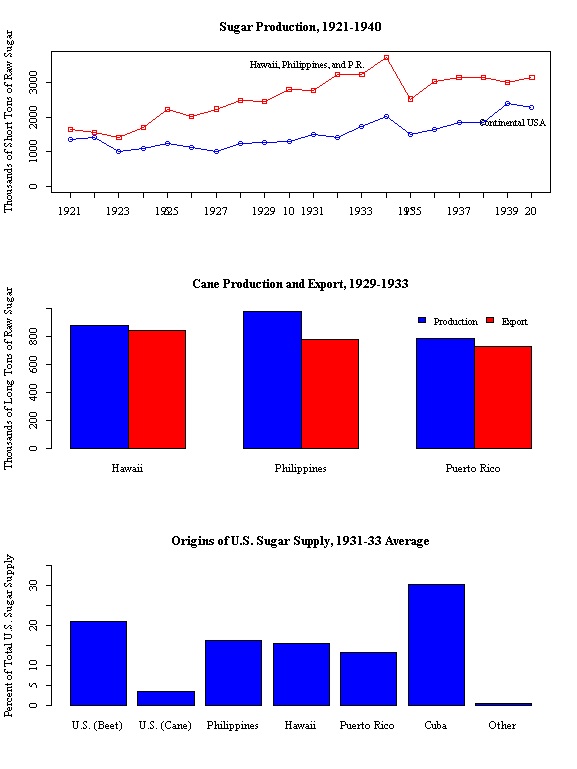
    Statistics on Sugar Production and Export

    My argument is that it’s not about the exports, per se, it’s about the ownership structure of the export industries. (Other export industries mattered too.) I’m writing a paper about this right now, so this is a wonderful and timely find.

    As Homer knows, first you get the sugar, then you get the power, then you advocate for the independence of your competitors so that you can slap tariffs barriers on them.

    First you get the sugar, then you get the power…
  • Fractionalization and Competition Reprise

    About nine months ago I posted about a peculiar finding about Indonesian local politics: the observation that there appeared to be high levels of political fragmentation in the most ethnically homogenous districts. It makes sense to observe that ethnic heterogeneity produces a fragmented party system, but not that ethnic homogeneity would do the same. I found this puzzling.

    Sometimes, though, a puzzling result is just a mistake. I think that that is what happened here. Together with my co-authors, I have been recreating political fractionalization and ethnic fractionalization scores from the original raw data, ethnicity data from the 2000 Census and party seat shares in the district legislatures from the General Election Commission. (We had been using indices created by someone else, probably for a different purpose.) In the process of doing this, I found a load of errors in our original data, many of them quite significant.

    Here is that same scatterplot using the corrected data.

    Ethnolinguistic and Political Fractionalization Indices

    The indices of political and ethnic fractionalization are the standard Herfindahl-style indices: if pi is the proportion of ethnic group (or political party) i in a district, then a district’s total fractionalization score is

    FRACTIONALIZATION = 1–Σ(pi)2

    Very straightforward stuff. In addition to a positive correlation between ethnic and political heterogeneity, we observe in this figure as well a classic example of heteroskedasticity: there is a higher variance in political fractionalization in more ethnically homogenous districts than in more ethnically heterogenous ones (a Breusch-Pagan test strongly rejects the null of homoskedasticity; some further digging indicates that the political fractionalization index is not normally distributed). We also see that the green dashed line (the linear fit) and the red solid line (the lowess fit) are nearly identical, which suggests that there isn’t any significant non-linearity in the bivariate relationship.

    Anyway, the question about what to do about the peculiar relationship that we’ve uncovered between ethnic fractionalization and political fragmentation turns out to be an artifact of some bad data. Happily, with the better data our earlier results appear even stronger: in Indonesian local politics, more political fragmentation -> lower budget surpluses.