Now that Prime Minister Najib Razak has dissolved Parliament, Malaysia’s elections are coming soon. Right now the two coalitions are in the process of nominating candidates for each electoral district. This process probably has no exact parallel anywhere else in the world: two multiparty coalitions are choosing candidates and parties to compete in single member districts with plurality voting. This post is about the logic behind that process.
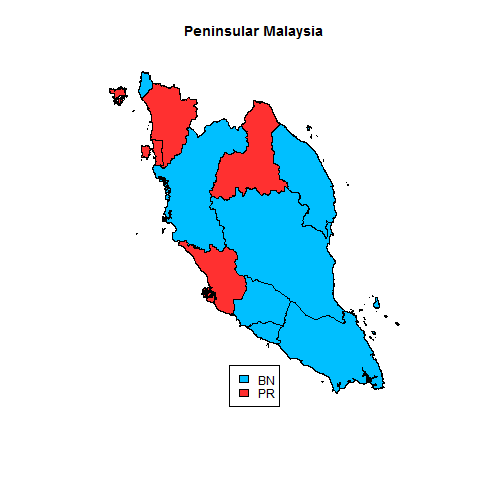
The two coalitions are the Barisan Nasional and Pakatan Rakyat. Each has several component parties. As before, I am concentrating primarily on the Peninsula.
Consider the perspective of BN component party like UMNO. As a member of the BN, UMNO wants the BN to win majority of seats in parliament. Yet conditional on winning, they wish UMNO to be as large as possible as part of the coalition. The problem is that electoral districts differ in the BN parties that they want to support. Ethnicity is obviously relevant: all else equal, we would expect that a majority Chinese district would prefer an MCA candidate to an UMNO candidate. The BN therefore stands to do better by nominating the MCA rather than UMNO, and UMNO has to balance its desire for one more seat with its interest in winning a majority of seats in total.
The decision is also strategic. Imagine that BN ignores the Chinese vote and nominates an UMNO candidate in a majority Chinese district. PR has an even stronger incentive to nominate a DAP candidate (remember that the DAP is not a Chinese party, but its constituency is predominantly Chinese and it is understood to advocate on behalf of policies consistent with Chinese interests). DAP will have a clear advantage; knowing this, the BN become less likely to nominate UMNO even if UMNO is greedy. Therefore, UMNO-DAP matchups should be rare, because they are off the equilibrium path. And in fact, we observed precisely zero UMNO-DAP matchups in GE12.
Figuring this out is actually pretty easy in the cases of Chinese versus Malay districts. It is much more difficult for Indian voters, who are almost never the majority in a district but whose party (MIC) has been an integral part of the BN coalition. So the BN need to get at least token electoral representation by MIC to keep the Indian vote across the peninsula. It is also more difficult when imaging the choices of the PR. An ethnically heterogeneous and relatively urbanized district outside of the north (where PKR has a historical base Penang and PAS in Kelantan) is hard to figure out, because it is hard to tell ex ante if the Islamist PAS, reformist PKR, or social democratic DAP has the best chance of victory. This is made even more difficult by the dynamic nature of party coalition building. By this I mean that PR parties believe that they need to prove themselves, so that (for example) if PAS can manage to win in a district in which it had not previously won, it might be able to “prove” to its opponents that it can govern, increasing its future expected vote share, and hence its political power. So a party like PAS might advocate for a chance to contest in a district where it would not traditionally contest, for dynamic concerns about what its popular constituency could become in the future.
In all, the nomination process in Malaysia today illustrates the fundamentally strategic nature of electoral politics in multiethnic and multireligious societies. But it is made far more complex and strategic by the ethnic and religious bases of most parties.
Earlier in the series: Preview (1) | Preview (2) | Preview (3) | Preview (4)

 Tom Pepinsky