
This is the fourth in a series of short reviews on modern Southeast Asian fiction. There will be spoilers. As always I’m pleased to have had the chance to develop these thoughts as part of a course, so credit is due to my student as well.
Previous review:
- Short Reviews of Modern SEA Fiction (1): Rachel Heng, The Great Reclamation
- Short Reviews of Modern SEA Fiction (2): Gina Apostol, Insurrecto
- Short Reviews of Modern SEA Fiction (3): Ayu Utami, Saman
Tash Aw, We, The Survivors
The problem with writing a review of Tash Aw‘s recent novel We, The Survivors is that I am biased, due to the plain fact that I find the subject matter to be intrinsically interesting. It covers so much in such a tightly written book: Kuala Lumpur, inequality amidst modernization, ethnicity and language, the mechanics of illicit economies, migration and citizenship. It is the truest book I have read so far this semester. Every character, every situation, every place, I can picture it in my mind. That the novel describes a wholly realistic tragedy and the hard lives surrounding it makes its realism particularly meaningful for people know Malaysia. I suspect that if you don’t know Malaysia at all, you will still find something to love about this book.
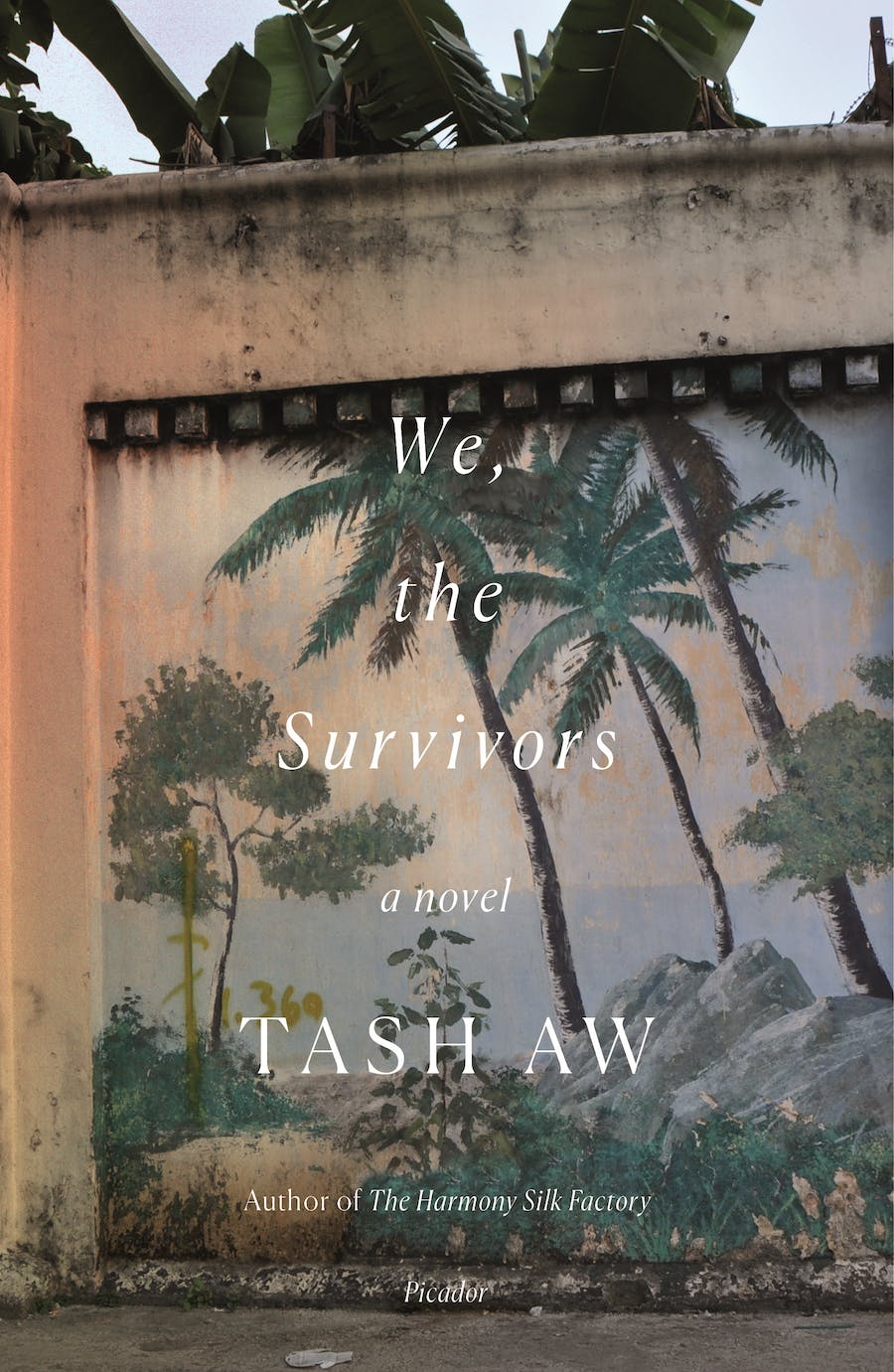
SPOILERS FROM THE JUMP: This is a story of a man named Ah Hock, who grew up hard in the Kuala Lumpur exurbs, and who murders a Bangladeshi man who trades in the illegal migrant workers that are so important to making contemporary Malaysia’s economy work. This introduction to the book is stark and sudden, but that is the core of the plot, and Aw beautifully captures the starkness of modern life for poor Malaysians living in and around KL. As a reader, you learn that Ah Hock is a convicted murderer early on, but you learn the story of the crime—and of Ah Hock—over the course of the novel.
The themes that Aw covers are central to modern Malaysian society and politics. One central theme is poverty: Ah Hock grows up in a broken home with a hardworking mother who fights to put food on the table. She and Ah Hock work a small plot of land in their village in the Klang Valley to make it productive enough to feed them, and to bring some farmed fish to market. Ah Hock spends some time in KL as well, selling pills and a bit of meth with Ah Keong, whom he knows from back in the village. Whereas Ah Hock is modest, Ah Keong is boastful: Ah Hock doesn’t take well to city life, but Ah Keong styles himself a gangster businessman, and he is quick to anger and to use physical violence to get his way.* Ah Hock works other, more legitimate jobs—at an outdoor seafood restaurant, on a fish farm—and he even marries a striving young woman named Jenny with her own dreams of wealth and prosperity.
But Ah Hock never gets ahead. His mother dies young of a preventable cancer. His marriage with Jenny is unhappy (she finds herself pulled into an Amway-like scam) and they drift apart. Ah Hock works tirelessly, to little avail. Ah Keong is ultimately a destructive force in his life, bringing him opportunity but also danger. In the end, it is Ah Keong’s scheming to find Ah Hock some illegal immigrants to support Ah Hock’s work crew that leads to the murder that drives the plot.
And yet what jumped out to me throughout the novel was Ah Hock’s insistence that he had a choice. This creates an interesting tension. On the one hand, the book describes social systems that are hard constraints. Poverty is poverty. The powerful will take what they can and the weak will suffer. The jungle and the sea will take back the land. And yet at key moments Ah Hock speculates—in first person, as the book is written—about his choices. What he might of done, the offramps he might have taken. Near the novel’s dramatic climax, it is therefore very poignant to read this passage:

Another central theme in the book is the complex interaction of race, ethnicity, citizenship, and class. In the standard schematic of peninsular Malaysian ethnicity, there are Malays, Chinese, Indians, and others. Malays were historically marginalized during the period of early capitalist development under colonialism, leading to a ranked ethnic system at independence in which the average material prosperity of the Malay community lagged behind that of Indians and especially Chinese. That’s the story.**
In We, The Survivors, the main characters are Chinese, and they are poor. They turn to petty crime to get ahead. They sell and take drugs, they work dirty and dangerous jobs outside, and they are exploited by a business class that is both Malay and Chinese. Their labor makes KL work. It thus inverts the standard narrative.
But there is another layer to this story, which is post-independence immigration. From the very first time I set foot in Malaysia, I remember the open secret of illegal labor migration. I saw it in the dark corners of Bukit Bintang, in the lorries on the federal highway, in the mamak stalls in Shah Alam, in the palm oil plantations of Sabah. These laborers come to Malaysia to find work and to escape oppression: they are Bangladeshi, Nepali, Rohingya, Indonesian.*** The book describes so plainly how this illicit economy works. Everything is completely realistic and believable.
There are also, at various points, descriptions of Black Africans living in Malaysia. This one stuck with me:
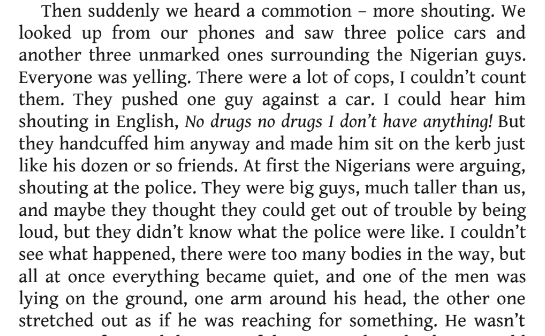
Again, this rings completely true to me. I can imagine it with no trouble at all.
As much as this is a story about poverty and inequality, it is also a story about migration and citizenship. Ah Hock’s father migrates to Singapore and disappears. Illegal migrant labor fuels the economy. Much depends on the ability to get papers, which establish a legal right to work, but which also establish a person as a legal and legible rights-bearing person. They can command higher wages and can call the police (even if, as the Nigerians demonstrate, there is no guarantee that a racialized Other will be protected). Those without papers are vulnerable, and so they are cheap.
The ordinariness with which characters treat the desperate lives of illegal workers is striking. They are simply expendable, and this comes up explicitly. A Malaysian audience might remark on the additional fact that many of the migrants are Muslims, and the absence of pan-religious solidarity in the face of the boundaries of citizenship and the exigencies of capitalist development. In the end, Ah Hock’s murder of the Bangladeshi fixer brings this home for us.
There is much more to enjoy in this book. Without spoiling the whole thing, I will mention that an important minor character is a young Malaysian PhD candidate writing a dissertation abroad, who has returned home to do her field research—which includes interviewing Ah Hock. She embodies everything cosmopolitan and modern: she doesn’t eat carbs (so no rice or biscuits, LOL), she finds the grocery store impossibly dirty, she is paralyzed by the injustice she sees, she is embarrassed for Ah Hock when he doesn’t know that she is in a same sex relationship, and so forth. She is a great foil for Ah Hock, and for any Western reader.
But in the end, We, The Survivors is just a well-written novel. Here is a book by an author who knows what he is doing, and it’s plain from the very first page that you are in for a difficult but rewarding account of modern Malaysia.
NOTES
* I couldn’t help but remember Jason (Ah Loong) from Sepet, the poor yet earnest Chinese boy from Ipoh caught up in a web of petty crime to make ends meet.
** Reality is more complicated than that. Someday I will finish a book that describes that reality…
*** I cannot count the number of times a Malay acquaintance back in the 2000s told me about urban crime in KL, only to clarify that the problem wasn’t Malaysians, it was Indonesians. Decolonize that.
 Tom Pepinsky
