Category: Language

  • Idle Speculation on the Term “Hanban”

    I recently had a very interesting conversation with a PRC citizen living in the United States about Confucius Institutes, which you can find around the world in colleges and universities supporting Chinese language and culture. We had been talking about ethnicity and nationalism in China—I had just presented this paper on subnational peripheries, which obviously applies to places like Tibet and Xinjiang—and I made some offhand remark about how it’s so meaningful that the oversight organization for the Confucius Institutes is known as “Hanban” rather than “Zhongguo Renmin Ban.”

    Let me explain, with the caveat that I speak precisely zero Mandarin, so I will rely exclusively on Wikipedia entries to make my point.

    Han is the Mandarin word for what we might call ethnic Chinese. This is the most numerous by far of the 56 officially recognized ethnic groups in mainland China. It excludes groups such as Hui (Chinese Muslims), Tibetans, Mongols, and so forth.

    Zhongguo Minzu is the Mandarin word for a member of the Chinese nation. Wikipedia tells me that it replaced the earlier term Zhongguo Renmin in the 1980s.

    I’ve always been interested in how Chinese politics deals with ethnicity. Clearly, the idea or theory of a Chinese nation in PRC official discourse is pan-ethnic, but in practice Han identity rules, with non-Han ethnic groups publicly represented as something like museum showpieces (just look at this). So my offhand remark was just my way of wondering if this is a little trace of how a Han-centric view of Chinese civilization pervades the PRC’s public diplomacy. Call it a residue of ethnic nationalism.

    I would be remiss without further observing that in Indonesian, the word Zhonghua has produced the word used to refer to Indonesians of Chinese extraction: Tionghoa. In Malay, Cina is used, resulting in the Malay wikipedia page about Chinese Indonesians being titled Cina Indonesia and the Indonesian wikipedia page about Chinese Malaysians being titled Tionghoa-Malaysia. There is, to my knowledge, no word to denote Han specifically besides suku Han (Han ethnic group).
  • Are We KPK, or is KPK Us?

    Yesterday, in “We Are…KPK!” I wrote about the current KPK crisis. Today, a reflection on why I translated KPK Adalah Kita as “KPK Is Us” rather than “We Are KPK,” as in the title of that post.

    The problem starts with the word adalah. It means “is/am/are,” in the context of (PRO)NOUN+TO BE+(PRO)NOUN, but as every beginning student of Indonesian will tell you, that’s not exactly right, because Indonesian does not have a verb “to be.” Yet this word adalah creeps into spoken and written Indonesian quite a bit. Compare Google hits for saya guru di [= I am a teacher in…] versus saya adalah guru di [= I am a teacher in…].

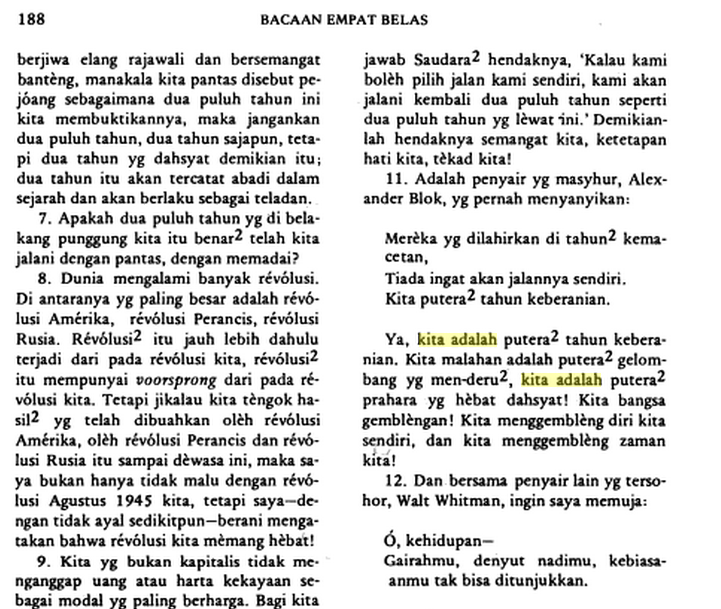
    My Indonesian teachers tell me that adalah is commonly overused by English speakers who are uncomfortable with “to be,” and that it’s also become more common in standard Indonesian in recent years. But it’s not new. When I was poking around for older uses of adalah, for example, I found this speech by Sukarno from August 1965:

    Screen Shot 2015-01-26 at 9.16.52 AM

    That’s Sukarno quoting Alexander Blok’s “Those Born in the Years of Stagnation.” (Now that is globalization.) He quotes Blok directly with Kita putera2 tahun keberanian [= We are the children of the years of bravery], and then immediately follows this up with Ya, kita adalah putera2 tahun keberanian [= Yes, we are the children of the years of bravery]. This shows one use of adalah, to emphasize “is” in “X is Y.”

    But I don’t think that emphasis is what’s going on here. Perhaps someone who speaks Indonesian better than I do will disagree with me, but KPK Kita and Kita KPK are both grammatically correct, yet neither sounds right. Is this an instance of language change in real time, the continuing evolution of Indonesian away from its origins as a simplified trade language?

    The other challenge in translating KPK Adalah Kita is knowing if the word order is deliberate or incidental. My guess is that it deliberate, and that “We are KPK” is less accurate then “KPK is us.” Why? Well, we can look for uses of the phrase Kita adalah KPK, and here is what we find:

    1. … sementara satu-satunya yang menjadi harapan kita adalah KPK (source)
    2. … benteng terakir kita adalah KPK (source)
    3. Hanya saja pesan kita adalah KPK fair dan adil. (source)

    In all of these, kita is modifying something else, and the translation is always “our X is that KPK …”. In fact, here is the only exception that I can see based on my very cursory overview of the first page of the g-hits:

    1. Katakan pada semua anggota KPK. “kita adalah KPK, ikon anti korupsi Indonesia.” (source)

    In that instance, the writer is channeling members of KPK themselves who are saying “We are KPK, the icon of anti-corruption in Indonesia.”

    Now does this matter? I think it does, and I think that it’s the same difference between having written Je suis Charlie versus Charlie est moi. In the former, you are showing that you stand by Charlie Hebdo; in the latter, you claiming more directly that Charlie Hebdo could have been you. I don’t think it’s an accident that few people chose to say Charlie est moi. I think it is absolutely deliberate that in this latest KPK scandal, for the majority of Indonesians, KPK is us.