Category: Economics

  • Bailing Out Stablecoins

    This morning we are learning the details of the U.S. government’s decision to bail out depositors at Silicon Valley Bank, a failed bank that specialized in dealing with tech startups and venture capital. SVB got into trouble by going long on treasuries in a low interest rate environment. We are no longer in a low interest rate environment.

    Federal deposit insurance is, in my view, one of the true miracles of modern American capitalism. It is a remarkable tool for ensuring financial stability and it is one of the fundamental prerequisites for making fractional reserve banking possible. It protects small investors and savers at minimal cost to the American taxpayer.

    The bailout that was announced is much more than deposit insurance. The details aren’t yet fully known but if the headlines are accurate, all depositors will be made whole, regardless of whether their deposits exceeded the $250,000 FDIC limit. As it turns out, the vast majority of SVB deposits were far in excess of that. Much of that was in medium-sized business accounts used for rent, payrolls, and so forth.

    We can quibble about whether or not it is a good idea to bail out those institutions; I am skeptical that it is a good idea to do that as a blanket policy, especially given that many of those institutions have revenue streams that far exceed their cash on hand. But regardless of those cases, regulators should draw a line at bailing out one of SVB’s biggest individual depositors: the stablecoin known as USDC.

    USDC is run by Circle Internet Financial Ltd. As a stablecoin, it promises to maintain a 1:1 exchange rate with the US dollar. It has delivered on that promise during a period of economic growth, but it was forced to drop that peg when SVB collapsed.

    Why is that? Because Circle had $3.3 billion in reserves at SVB. That’s right: their holdings were 13,000 times the maximum amount ensured by the FDIC. Bailing out Circle, and with it USDC, requires serious money.

    What is the problem with bailing out this depositor? Why does it require special scrutiny? The answer is because the depositors who run stablecoins use their deposits differently than any other depositors do.

    Stablecoins are cryptocurrency. They promise to deliver all of the benefits of fiat currency without government interference or regulation. The idea is that the computer can use blockchain technology and algorithmic trading strategies to produce an alternative to the dollar without relying on the mechanism of a central bank. Stablecoins are interesting because they promise, in the best case scenario, to reproduce something that I can use already: a US dollar, which is firmly and irrevocably pegged to its own value already.* The benefit of a stablecoin like USDC over the US dollar is that it enables transactions beyond the reach of the normal payments system, which can be used for activities like buying illegal things, pretending that you’re beyond the reach of the U.S. government, and speculating about our techno-future.

    As it turns out, stablecoins are only stable if people believe that they are stable.** And people will only believe that they are stable if they are backed by something—that is, collateralized. That is what Circle’s SVB deposits were: a large pot of money that comprised some of its collateral to defend USDC’s value. When that money became uncertain, USDC had to drop its peg. It was no longer a stablecoin because its collateral was in question.

    The problem become clear when we put all of the pieces together: SVB was acting as a central bank for USDC. Ensuring Circle’s deposits means that the US government is now the central bank for USDC.

    Now, the politics that will follow from this promise to be very interesting. Crypto defenders will not want to notice that crypto got a government bailout to ensure its value. Crypto opponents might not want to acknowledge that crypto just got a big signal that it is too big to fail.

    The US government bails out financial institutions from time to time. And the Fed is our central bank, after all. But it does so in exchange for the ability to regulate those financial institutions, and to take ownership over their assets when their activities threaten systemic financial stability. That is what the US government should do now in response to USDC. Otherwise, the US government should allow USDC to try to use its algorithms to save itself, which is the whole point of stablecoins in the first place.

    Either the US government is the central bank that guarantees the value of USDC, or it is not. There is no third option.

    NOTES

    * This is a tautology, but it is on purpose.

    ** In the words of an old friend, decentralized algorithmic stablecoins are impossible. See more here. And here.
  • Economic Growth Under Authoritarianism and Democracy: The Indonesian Case

    Indonesia is one of most striking cases of economic transformation in modern history. At independence, Indonesia was a low-income country subject to centuries of exploitation and resource extraction under Dutch colonial rule. By the 1990s it was one of the Newly Industrialized Economies of East and Southeast Asia. Today, it is a middle-income country, classified by the World Bank as a Lower Middle Income country but not far from Upper Middle Income status. This economic transformation produced a measurable increase of material wellbeing for hundreds of millions of people. Prior to China by the 2010s, no country’s economy had grown so quickly for so long as did Indonesia’s.

    Indonesia is also a paradigmatic case of economic growth under authoritarian rule. The New Order regime arose in the wake of the brutal extermination of the Indonesian left, and was headed by a general-turned-president who tolerated only limited organized opposition and almost no anti-regime mobilization for over three decades. Soeharto, though, legitimated his rule as providing stability as the foundation for prosperity and economic transformation, eventually becoming known as Bapak Pembangunan or “Father of Development.”*

    Since the collapse of the New Order and the transition to democracy in 1999, following the economic crisis of the late 1990s, many Indonesians have lamented the loss of the feelings of optimism, dynamism, and economic progress under the New Order. Inequality has continued to rise, and the Indonesian economy, today, plainly does not serve all Indonesians equally. And one often encounters a general sense** that the New Order was a time when things were getting a lot better, a lot faster.

    (There is something lurking deeper here about how Indonesians recall the terms of authoritarian citizenship, although that is a post for another time.)

    One possible explanation for the belief that Indonesia’s economy was somehow more dynamic under authoritarianism is that the New Order actually did create higher economic growth than did its democratic successor. Indeed, this is a view that I have often shared in my teaching and in my research—I do not support authoritarianism, but I nevertheless insist that we must look the facts of economic development under Soeharto squarely in the face. But more than 20 years after the transition to democracy, is it actually true that New Order Indonesia grew faster than democratic Indonesia has since?

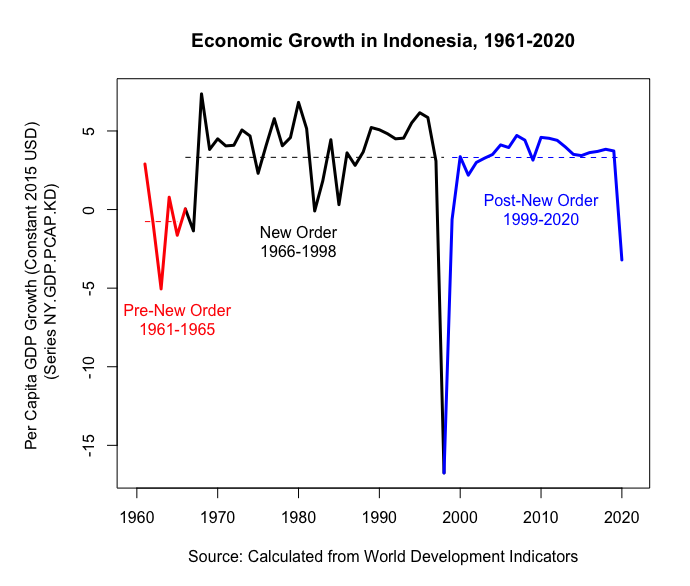
    As it turns out, no. Prompted by an email exchange among some very respected Indonesia-watching colleagues, I decided to do a proper test of the relationship between regimes and economic growth. To do so, I grabbed data from the World Bank on Gross Domestic Product per capita between 1960 and 2020, measured in constant 2015 US Dollars. This ensures that we are doing the proper comparisons over time, adjusting for inflation and purchasing power (although see the caveat at the very end of this post). I then calculated economic growth as the year on year percentage change, and plotted this series over time by separating out the pre-New Order period (1961-1965), the New Order period (1966-1998), and the post-New Order period (1999-2020). Here is what we see.

    The thick lines are yearly growth. The dashed lines are the average within the period in question. And it is clear: average growth from 1966-1998 was no better or worse than average growth from 1999-2020. Measured this way there is simply no evidence that New Order Indonesia grew faster than democratic Indonesia.

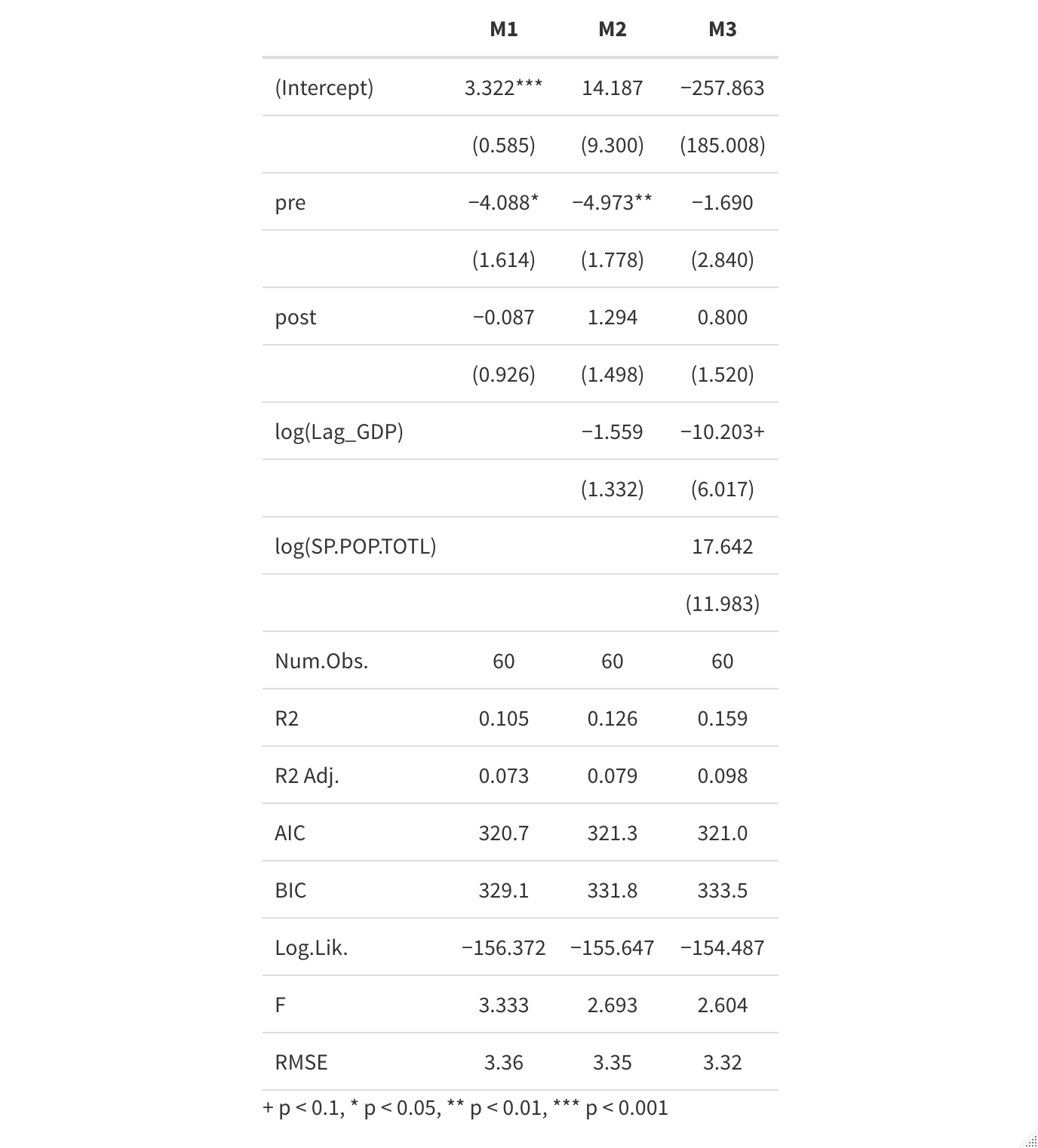
    We can test this in a regression framework too:

    There is no significant relationship between a dummy variable capturing “post-New Order” and economic growth in any of the models. This is true however I model this relationship: M2 above controls for the natural log of the previous year’s GDP in order to reflect the well-known convergence hypothesis of declining rates of growth at higher levels of income, and M3 also controls for the log of Indonesia’s population size.

    All in all, I just do not see any evidence that Indonesian economic growth was faster under authoritarianism than under democracy.

    This matters, and it doesn’t. It matters in the sense that to understand Indonesia’s political economy, we need to appreciate just how much Indonesia has grown after the end of the New Order. That is a lot of sustained economic growth.

    And it matters in a second way too. When you look at the graph above, you also can’t miss that Indonesia’s economic growth has been much more stable under democracy than it was under authoritarianism. That’s not nothing. Indonesia is not lurching from crisis to crisis, the way that New Order Indonesia had a petroleum crisis, then the early 1980s crisis, then the Asian Financial Crisis. People ought to be writing about the general macro-stability of Indonesia’s democratic economic performance, even given a lot of global economic turmoil.

    But these results also don’t matter in the sense that the political fact of nostalgia for a sense of stability and order does not depend on whether the economic facts are consistent with it. People will remember the New Order as a time of order; that, truly, was the point.

    And the other thing is inequality. That might really be the story of democratic Indonesia’s political economy, how such wealth and prosperity can emerge and persist in a country still beset by serious challenges. That said, it is important to recognize not only that there are so many extremely wealthy Indonesians, but also that there are so many nouveau wealthy Indonesians.

    There is an important caveat to all this, though. The data that I’ve used here are derived from the World Bank, which calculates GDP per capita in a lot of different ways but only has real GDP data in US dollar terms. What I would really like to have is the same series, but in the (inflation-adjusted) local currency unit: real GDP per capita measured in constant rupiah. I don’t have immediate access to that, and although I can grab the current data from Indonesian government websites they do not go back in time to the 1960s. So an open call: if you, reader, have access to that data series, I will make the same figure and estimate the same regressions, and report the results here.

    NOTES

    * I doubt that this was a spontaneous expression of endearment. Someone in the regime probably coined the phrase and then encouraged it to spread.

    ** Sometimes called “Indonesian SARS”, which stood for Sindrom Aku Rindu Soeharto [I Miss Soeharto Syndrome].