Category: Economics

  • Decentralization, Accountability, Food Security, and Papua

    Yesterday Cornell SEAP series welcomed a visiting scholar from the State University of Papua who presented on food insecurity in Papua on our weekly Brown Bag. The talk was grimly fascinating. Papua and West Papua, the two provinces at the eastern end of Indonesia which occupy Indonesia’s portion of New Guinea, has always been a (literal) outlier for Indonesian studies. The presentation showed clearly that amid abundant natural resources, relatively strong economic growth, nearly every district in these two provinces suffers from dangerously high rates of food insecurity.
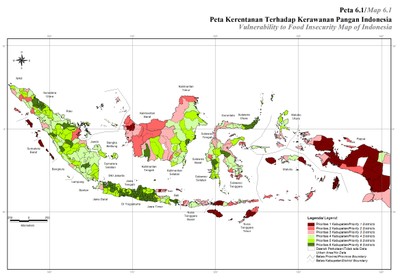
    Food Insecurity in Indonesia (source: http://www.foodsecurityatlas.org)

    This is not starvation (although this does happen), but something more like systemic malnutrition or high variance in food availability. There was one image of four Papuan boys suffering from stunting which will stay with me for a long time.

    Since at least Bates 1981, we have known that famines and food insecurity have political rather than environmental or agricultural causes. Just so in Papua. I asked the presenter about how political decentralization in Indonesia has affected the ability of local governments in Papua and West Papua to adopt good developmental policies. I will not post her response here, but suffice it to say that it was not a positive one. Moreover, there was a sense in her remarks that district-level governments in Indonesia (the district being the tier of government most empowered by decentralization, as opposed to the village or province) really aren’t where the main problems lie. Local governments aren’t the one’s responsible for plans to clear huge swaths of land in Papua in order to plant rice for export to the rest of Indonesia, or non-food crops for the rest of the world. After all, Papuans traditionally do not eat rice (although this is changing) and rice does not really grow well there anyway (which is why Papuans traditionally do not eat it).

    All of this dovetails very well with a paper that I recently finished on accountability and Indonesian development in contemporary era. I’ll be presenting it in a workshop on oligarchy and accountability at the University of Sydney this December. I conclude the paper by writing that “We simply do not know enough about the relationship between local policymaking and national politics even to describe the interaction between institutional innovations, the national oligarchy, and informal political power in the regions.” Yesterday’s presentation on food insecurity in Papua tells me one thing: that’s where I ought to go to look.

  • Guess the Colonial Power

    As I polish up a first serious draft of a paper on decolonization, today I came across a discussion of “annexation.” I invite readers to peruse the following and imagine which tropical territory is being discussed.

    Many…who felt…that annexation was inevitable sentimentally opposed it. It would be far pleasanter, were the world constituted differently, for  many states, representing different planes of culture, different races, and differing attitudes toward life to exist beside one another in amity. But the world, simply, was not constituted that way.

    In the Nineteenth Century, as always before and always after, it was a realistic world, one whose separate parts continually came closer together. _____, potentially, had things that the world wanted. Left untroubled, the _____ans themselves clearly would not produce those things. Yet it could be fairly argued that they had no right to fail to do so. No one of radical opinions would grant the right of a private owner of great acres, of a factory, of a ‘means of production’ of any kind, to shut it off from common use merely because it was the owner’s whim or nature to do so. How then could it be argued that far greater proprietors under the name of race or nationality should exercise that right?

    Seems like something right out of the “enlightened” part of the colonial era, right? Say, mid-19th century on. Probably some Belgians talking about rubber in the Congo Free State. Or the British talking about rice in the Irrawaddy delta. The sentiment is not so much that the European should be enslaving the colonial subject, but rather that the colonial subject cannot be a proper member of the global economy without some direction. What is an enlightened European to do? (I love the use of the construction “it could be fairly argued” here.)

    Turns out, this quote is of more recent vintage, and it is not European. It is taken from John W. Vandercook’s 1939 book King Cane: The Story of Sugar in Hawaii (New York: Harper & Brothers Publishers), pp. 42-43. Yes, this is a quote is referring to the annexation of Hawaii, so that those noble yet indolent Hawaiians could be directed to grow sugar.

    Americans owe it to themselves not to forget this chapter of our history. For more, I highly recommend McCoy and Scarano’s Colonial Crucible on the role of empire in the construction of the modern American state.