Category: Economics

  • Differences in Differences: The Gaza Withdrawal

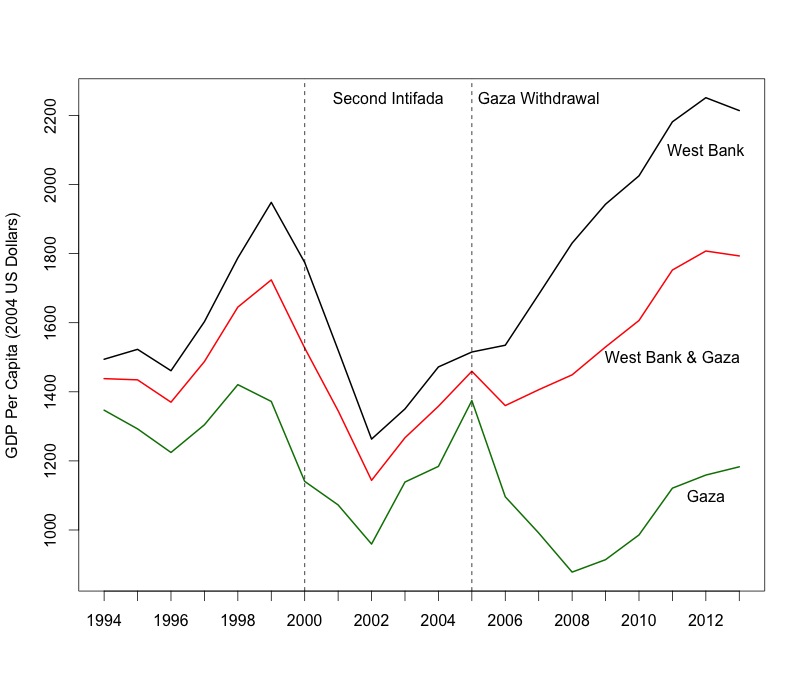
    I recently returned from an incredibly interesting visit to Israel and Palestine. Among the many interesting things that I had a chance to learn about was the stark difference between the West Bank (governed by Fatah) and the Gaza Strip (governed by Hamas). During one meeting in Ramallah, a presenter from the Palestinian Central Bureau of Statistics showed us this very illuminating figure comparing gross domestic product per capita in the West Bank and Gaza.

    10015006_10100884063581294_4178632248120555894_o

    This is blurry and hard to see (and written in Arabic), but the handy website of the CBS allows me to recreate it exactly using these data, with some additional annotations.
    Rplot

    Now we’re talking.

    Immediately apparent to all the social scientists in my group was the dramatic divergence in GDPPC trends after 2005. It has always been the case that Gaza is poorer than the West Bank, but Gazan living standards become much worse after 2005. A simple diff-in-diff analysis makes this point abundantly clear.

  • Call: lm(formula = GDPPC ~ Gaza * Withdrawal, data = dat.test)

  • Coefficients

    Estimate Std. Error t value Pr(>|t|)
    (Intercept) 1563.40 60.41 25.879 < 2e-16 ***
    Gaza -340.07 85.43 -3.981 0.000319 ***
    Withdrawal 345.19 90.06 3.833 0.000489 ***
    Gaza:Withdrawal -490.43 127.36 -3.851 0.000465 ***

  • — Signif. codes: 0 `***’ 0.001 `**’ 0.01 `*’ 0.05 `.’ 0.1 ` ‘ 1

    These results are consistent with at least two interpretations. The Fatah view—remember that we obtained the data from an official who almost certainly has links to Fatah—is that Fatah rules better than Hamas. An alternative view though, which some Israelis might support, is that the Israeli withdrawal is harmful for Palestinians. Because Israel is responsible for security and order in some of the populated areas of the West Bank, its presence ensures a more stable environment for economic activity than one would see without Israel, perhaps even in those places where the Palestinian authority does have full responsible for internal security and order. These data cannot adjudicate between these two interpretations. It might be interesting to see if Governorate-level data could do so by differentiating across areas of Israeli security presence.

    Something else that might not be so apparent, though, is that Gaza actually fared slightly better relative to the West Bank during the Second Intifada. Here is another simple diff-in-diff analysis.

  • Call: lm(formula = GDPPC ~ Gaza * Intifada, data = dat.test)

  • Coefficients

    Estimate Std. Error t value Pr(>|t|)
    (Intercept) 1819.93 57.39 31.710 < 2e-16 ***
    Gaza -656.39 81.17 -8.087 1.3e-09 ***
    Intifada -337.31 104.78 -3.219 0.00272 **
    Gaza:Intifada 318.76 148.19 2.151 0.03826 *

  • — Signif. codes: 0 `***’ 0.001 `**’ 0.01 `*’ 0.05 `.’ 0.1 ` ‘ 1

    If you look carefully you can see that the worst of the Intifada (2000-2) saw Gazan GDPPC fall less steeply than in the West Bank, and climb more rapidly in the latter phases. I’m not sure what to make of this, except for to observe that poorer places have less to lose under conditions of political and economic turmoil.

  • Paul Romer and the Principles of Academic Engagement

    Paul Romer has written a couple of really biting commentaries on the contemporary state of economic theory (this and this). The enemy is “mathiness,” a term he employed—if not coined—in a recent paper in the American Economic Review Papers and Proceedings.

    Like mathematical theory, mathiness uses a mixture of words and symbols, but instead of making tight links, it leaves ample room for slippage between statements in natural versus formal language and between statements with theoretical as opposed to empirical content.

    There’s a lot more to this debate, and it will no doubt continue to unfold in the coming weeks. (And in the academic economics blogosphere, no less!) The debate among economic theorists has very little relevance for how to do contemporary political science research, but it will still be interesting to follow for anyone interested in the history of economic theory, the politics of macroeconomic policymaking, and so forth. I do agree that reading Romer’s interpretation of the point of Milton Friedman’s “The Methodology of Positive Economics” helps me to put it in a new light.

    What catches my eye, though, is how Romer describes the foundations of academic collaboration in a science of economics.

    a) We trust that what each person says is an honest account of what he or she thinks is true.
    b) We all recognize that reasonable people can differ and that no one has privileged access to the truth.
    c) We take seriously the claims of people who disagree with us.
    d) We are ready to admit that others might be right that each of us might be wrong.
    e) In our discussions, claims that are recognized by a clear plurality of members of the community by as being better supported by logic and evidence are the ones that are provisionally accepted as being true.
    f) In judging what constitutes a “clear plurality,” we put more weight on the views of people who have more status in the community and are recognized as having more expertise on the topic.
    g) We update the status of a members of our community on the basis of his or her contribution to progress a clearer understanding of what is true, not on the basis of “unwavering conviction” or “loyalty to the team.”
    h) We shun, or exclude from the community, someone who reveals the he or she is not committed to these working principles.

    I’m not sure I agree about the place of experts with status in the community: it puts a heavy burden on the experts to be self-critical in a way that I just don’t think is realistic. But in general this seems like a good set of principles. If we hold the commentary on experts and status aside, in fact, Romer’s principles can be simplified into just four.

    Modified Principles for Academic Engagement
    1. Mostly everyone is really smart
    2. Mostly everyone is really trying
    3. Mostly everyone is usually wrong
    4. All of these apply to you too, especially 3