Category: Current Affairs

  • Why Greece 2015 is Not Indonesia 1997

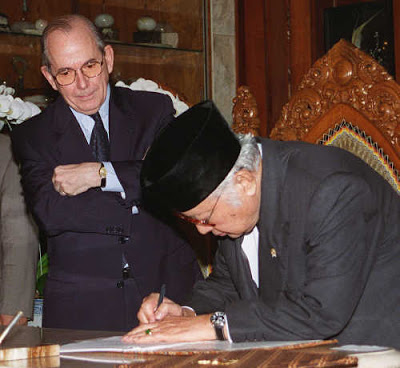
    The Iconic Image of IMF Power: IMF Managing Director Michel Camdessus looking on as Indonesia's President Soeharto signs a second bailout agreement, January 1998
    The Iconic Image of IMF Power: IMF Managing Director Michel Camdessus looking on as Indonesia’s President Soeharto signs a second bailout agreement, January 1998

    Yesterday, Joseph Stiglitz argued that Greeks should vote “no” on the upcoming referendum to accept or reject the troika’s terms. In response, noted Indonesian scholar and public figure Ulil Abshar-Abdalla tweeted this:

    Well, Stiglitz was a forceful critic of the IMF right after the 1998 Asian Financial Crisis. As he wrote in the New Republic in 2000:

    I was chief economist at the World Bank from 1996 until last November, during the gravest global economic crisis in a half-century [the Asian Financial Crisis, to which Ulil is referring]. I saw how the IMF, in tandem with the U.S. Treasury Department, responded. And I was appalled.

    But Ulil’s point does raise interesting questions. Indonesia’s years of IMF-managed adjustment and austerity were extraordinarily painful. Greeks today have a choice between austerity and autonomy. Shouldn’t we learn from Indonesia’s experience—and the experiences of other countries like Indonesia that have endured painful austerity and adjustment measures—to recommend against the austerity path?

    I would not go so far, because Greece 2015 really is different than many of these previous cases, in two key respects.

    The first difference is the biggest one: the currency union between Greece and the other Euro members is a political project. Europeans have shown themselves to be incredibly tolerant of austerity for the sake of maintaining the Euro, because the Euro is not simply a very hard peg of the Greek currency to all the other currencies of the Euro area. Leaving the Euro is not the same as a devaluation of the rupiah versus the dollar, because it requires both (1) a strong and nimble Greek monetary authority to create a new currency overnight, and (2) an abandonment of a “certain idea of Europe.” That idea that may have once been held by only an elite minority, but today is widely shared, it has real political meaning, and the Euro currency itself is part of that. Even in Greece.

    The second big difference between Greece 2015 and many of the Asian cases—especially Indonesia and Malaysia—is that Greece today is a democracy. This matters at a fundamental level for understanding what policies get made and why (as I argue here). Indonesia’s crisis was so bad for so long in part because the outgoing Soeharto regime struggled mightily not to implement some of the least controversial aspects of the IMF’s adjustment packages.* In Malaysia, the counterfactual case of the country that rejected the IMF and managed to withstand the crisis fairly well, authoritarian stability was a prerequisite for making the difficult decisions associated with heterodox adjustment. The politics, the patronage, and the public outcry along the way were supremely ugly. Greece today cannot count on the strong-arm tactics of a Mahathir Mohamad to keep domestic politics in line. Nor does it need to fear the unabashed kleptocracy of an aging sultanistic dictator. For better or for worse, Greece may look instead to South Korea, a democratic regime whose IMF-mandated rescue turned out to not be quite so bad.**

    Does the fact that Greece 2015 is not Indonesia 1997 mean that Greeks should vote to accept the troika’s terms? Not at all. It does, however, help to illustrate just how unique the current Greek situation is. Yes it is true that once again, a small open economy faces a choice between austerity and autonomy, with substantial long-term risks for the very core of its national economy associated with both choices. The austerity package is stark, perhaps unimplementable, and yet to label Greece’s choice in between austerity versus democracy is too facile. I do see a strong argument, however, for greater Europe to shoulder more of Greece’s adjustment risk than it currently does.

    Alexis Tsipras and Jean-Claude Juncker: Still friendly after all these months
    Alexis Tsipras and Jean-Claude Juncker: Still friendly after all these months?

    NOTE

    * Like the plan to abolish rotten son Tommy Soeharto‘s monopoly on clove marketing and exports.
    ** If you would have told me in October 1997 that by October 2012 I’d be listening to “Gangnam Style” and installing a Samsung refrigerator…

  • Malaysia’s Opposition Coalition Is Dead

    Seven years after it was formed, Malaysia’s most successful three-party opposition coalition, the Pakatan Rakyat (People’s Pact), is officially dead. This is a blow for the many Malaysians who support an alternative to the Barisan Nasional regime that has ruled Malaysia in one form or another since 1957.

    The final blow came from Democratic Action Party Secretary General Lim Guan Eng, who announced two days ago that the PR “ceased to exist.” The proximate cause of that, in turn, was a recent decision by the general assembly (muktamar) of the Pan-Malaysian Islamic Party (PAS) to stop collaborating with DAP. This followed what Bridget Welsh has called a “purge of the progressives” during the muktamar, in which conservatives from the “ulama wing” grabbed all of the party’s important leadership posts.

    Those final details are important, but the roots of the PAS-DAP split are structural in nature. PAS is an Islamic party, overwhelmingly supported by ethnic Malays. DAP is a social democratic party, overwhelmingly supported by ethnic Chinese. As I wrote in 2007,

    in many ways, each opposition party has more in common with the BN than it does with other opposition parties.

    And in 2013, after the results of the 2013 General Election came in and remarking upon Anwar Ibrahim promise to step down, I observed that

    Without the pluralist PKR and Anwar’s dynamic leadership, it is unclear how a largely Chinese social democratic party and an Islamist party can remain in the same coalition.

    Back in 2007, writing in the wake of the split of the Barisan Alternatif, I was skeptical about the possibility of cross-ethnic cooperation in the near future. That was wrong: cooperation did work from 2008 until 2015, and generated a majority of votes going to PR instead of the BN in 2013. We now face the possibility that PAS will cooperate more formally with UMNO and the BN. Such cooperation would align Islamic and Malay-nationalist agendas (which have quite a bit in common anyway) while further sidelining non-Malay and non-Muslim voices in this diverse multiethnic and multireligious country. This makes sense from UMNO’s perspective given that UMNO now dominates the BN to an unprecedented extent, and no longer has a parliamentary supermajority.

    So what’s next? From my vantage point in Ithaca it is hard for me to say, but there are four important places now to watch.

    First, Persatuan Ummah Sejahtera Malaysia (PasMa), which translates to something like the “Union of the Faithful for a Prosperous Malaysia.” PasMa describes itself as a “watchdog” group to ensure that PAS does not cooperate with the BN, and represents (after a fashion) those progressives who have been purged from PAS. And its chief Datuk Phahrolrazi Zawawi is now calling for a new Islamic party to participate in a new opposition coalition. Can PasMa be that party? Only time will tell.

    Second, PKR, the People’s Justice Party. Its stance is firming up as I write this: just a couple hours ago PKR echoed Lim Guan Eng in declaring PR dead. Quo vadis PKR? It is not yet clear.

    Third, the BN’s component parties. If PAS moves to cooperate more formally with UMNO, then UMNO and the non-Malay parties face an interesting choice. The Non-Malay parties will almost certainly resist bringing PAS into the coalition, for that dilutes their voice even further and threatens their core interests as well. Yet I would not rule out a formal alliance between UMNO and PAS in the near future, even if the non-Malay parties quit in protest. If so—and believe me this is a hypothetical—this would signify the most significant party system change in Malaysian history.

    And fourth, state-level PR governments. Yes, the PR is dead, but PR-based coalitions still rule in important states such as Selangor, Penang, and Kelantan. Selangor is the critical case: here, unlike in Penang or Kelantan, PAS must remain in alliance with PKR and DAP for the government to stay together. Will it? Selangor is a relatively prosperous, multiethnic, “suburban” state near Kuala Lumpur, not a rural northern Malay heartland state. It is also the site of the infamous Selangor crisis. PAS members there almost certainly differ from party members in the Malay heartland. This may be where to look to see where Malaysian party politics is heading. Selangor Backbenchers Club chairman Ng Suee Lim recently said that the government would remain in power so long as the three parties

    could still agree on certain common issues and be respectful to each other

    We will have to see if that will be possible.