Category: Current Affairs

  • A Political Economy of Shitcoins

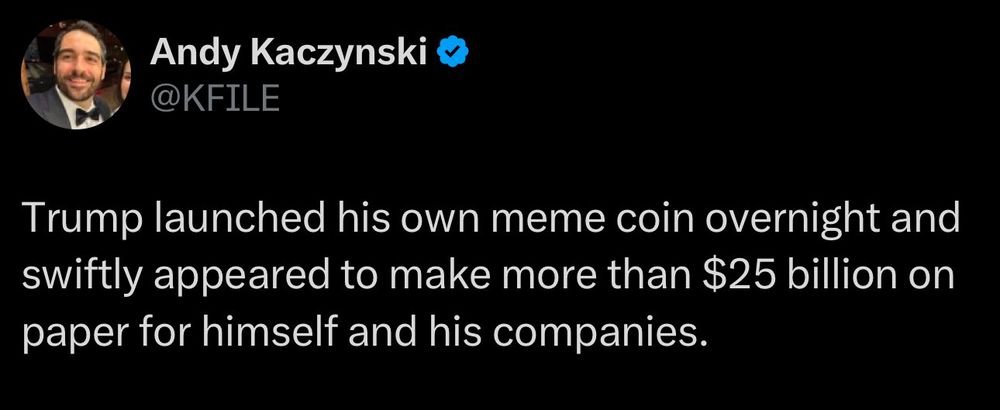
    “US President-elect Donald Trump has launched his own cryptocurrency, which quickly soared in market capitalisation to several billion dollars.” This is the first sentence of a BBC story about $Trump, the new meme coin floated by a company “which has previously sold Trump-branded shoes and fragrances.” Coverage of this development has been interesting. The NY Times writes, “Trump Begins Selling New Crypto Token, Raising Ethical Concerns.” The Financial Times, by contrast, is brave enough to state it plainly: “The president-elect of the US is promoting a shitcoin?”

    The word shitcoin is exactly the correct word for $Trump. But Trump’s shitcoin raises bigger questions about the future of crypto in the incoming administration, which faces no constraints whatsoever from the other branches of government when it comes to ethics, bribery, or even pretending to manage the conflicts of interest of all members of the executive branch.

    What are these shitcoins about? Google shitcoin (turn off AI) if you want to learn the basics. I can summarize.

    • Do shitcoins have value? No.
    • Are shitcoins a grift? Yes.
    • Are they volatile, like, Ponzi-level volatile? Yes.
    • Are extremely wealthy people planning to use shitcoins to transfer wealth to themselves? Yes.

    But shitcoins like $Trump have a political economy that is deeper than all that.

    It is tempting to see shitcoins as a modern form of financial snake oil. But when the incoming president is promoting a shitcoin, it is not snake oil. $Trump is the Springfield Monorail. The difference is that snake oil salesmen exploit individuals, whereas shitcoins exploit communities. Snake oil buyers suffer individual consequences, whereas shitcoins have externalities with aggregate social consequences.

    My conjecture is that most shitcoin-pushers are interested in a quick buck. But some have a much grander and more insidious ambition, and that is to become too big to fail.

    Here is what I mean. Financial products have value to an individual because of their social value. A dollar is worth a dollar because it comes with the backing of a large and powerful state. A stock price reflects (OK, OK) the aggregate information about the value of the underlying asset. A shitcoin has value so long as people buying it think it has value—more precisely, it has value in the sense that people buying a shitcoin give it value. A rug pull is what happens when shitcoin-pushers exploit these dynamics.

    An argument for free and unregulated markets in financial products is that competition weeds out bad investments and incentivizes people to make good investments. That is a good theoretical argument, but it is unrealistic as a description of actually-existing capital markets, which is why every developed capital market in the world is regulated in some fashion. Those regulations enable financial capitalism to work better. Deposit insurance, for example, encourages people to save rather than hide their money under their mattresses.

    Implementing deposit insurance is a political action, a regulatory choice. Deposit insurance is a good idea because having people use banks rather than mattresses is a good idea, not just for them, but for the entire financial system. We know this because when the United States didn’t have deposit insurance, bank failures created bank runs which were bad for the entire financial system. You can repeat this story for any country in the world, for any type of saver or investor, in any type of financial product. The state intervenes to stabilize the financial system, because financial system health is a public good.

    Most shitcoin-pushers are interested in quick rug pulls for quick bucks, and suckers be damned. Most ordinary investors and savers don’t care: a fool and his money are soon parted, and it’s great to know that you are 100% insulated from shitcoins if you are not a fool. But what would happen if a shitcoin-pusher were to attract investments from a substantial proportion of savers or institutional investors?
    In that scenario, the collapse of a shitcoin would have systemic consequences. It would become necessary to bail it out.

    I don’t mean that a collapse and bailout is going to happen right now. Those are just paper profits, and perhaps it’s just one big Saudi oligarch buying access. I mean, a shitcoin collapse is now on the table as possible future outcome in a world in which so much money is going into a shitcoin launched by the incoming president’s branded-fragrance-marketing subsidiary.

    If you think that this is outlandish, remember the 2009 financial crisis and ensuing bailout. MBSes and CDOs and all those exotic financial products that rested on a house of cards? We all paid for the excesses of a few extremely powerful financial institutions. Even thought the greed and graft was plainly infuriating, there was no option but to bail them out. I supported the financial sector bailout then, and I still do today.

    That is the greatest scam that you could ever imagine: exploiting as many individual savers and investors as possible, and then the federal government cleans up the mess. I think the biggest shitcoin-pushers know exactly what they are doing.

    Barney Gumble: What about us brain-dead slobs?
    Lyle Lanley: You’ll be given cushy jobs.

  • Living through the Next American Political Order: Institutions Will Comply, and You Will Be Made Complicit

    I woke up this morning to see that Donald Trump had been elected president again. Like roughly half of American voters, this is not the outcome that I had hoped for. Politics, like history, is chaotic and uncertain. Yet the victorious party in American politics last night has campaigned for years on a clear platform and a coherent vision of America’s future. Voters chose that party, and institutional guardrails will not constrain the next government. American life will change accordingly.

    I did not predict this outcome. I predicted no outcome, because I did not know, and what I did know made me fearful. But about two weeks ago, liberals like me started to acknowledge—quietly, privately—that we thought Trump would win again. So I am not surprised, exactly. Nor is any woman I know, including my own daughter.

    But I am demobilized and discouraged nevertheless. The results confirm some of my worst fears about what Americans will support when given the choice. And now I, like others who share my views towards the next administration, must ponder how to make our way through the coming years. The threats facing Americans are not all the same, and so they will be borne unequally; people with my characteristics will face fewer risks than many others. And yet all of us will need to wake up every day and make our way through our lives, mindful of the new political world we live in, but with the same obligations as ever amidst an uncertain and frightening new future.

    When I wrote “Life in Authoritarian States is Mostly Boring and Tolerable” in 2017, I was anticipating a situation much like this one. And so in the early hours of the second Trump administration, here are the implications I see.

    Liberalism is Not That Popular. I am a liberal at heart. I believe in individual autonomy, collective self-determination, and political equality. I believe that this implies a certain form of politics, including the rule of law, republicanism, and proceduralism. But my values are not that popular among the voting public, and the consequences are apparent. The liberal strands (dare I say “foundations”) of American politics shall be undermined, and some dismantled. Anyone who thinks that America has never been a liberal republic will find evidence to support their position as well.

    Your Institutions Will Comply with the Administration. The next administration will likely destroy some institutions, but more likely, it will work with and reshape existing institutions to suit its purposes. The mechanisms through which this will happen are legal and financial. Concretely, this is how they will direct the corporate sector, constrain universities, and shape the mass media. Electoral authoritarian regimes routinely do this around the world. Our next administration will follow that playbook. There are plenty of past precedents in U.S. history, and comparative examples around the world right now.

    That means, there will come a time when the administration tells the press not to publish a story, for reasons that are transparently nonsense. The press will comply. There will come a time when universities are told what they can teach and what students can do. They will comply too. They will comply because the consequences of noncompliance are too severe, even if every single person working within those institutions opposes the actions taken in their name.

    You Will Face A Choice. Many people are going to be made vulnerable under the coming administration, especially anyone who lacks a U.S. passport, women, and gender nonconforming people. Most people living in the U.S. will not be so vulnerable, but we will operate within a system in which our friends and neighbors face existential risks. And because we are embedded in institutions, we will become the agents of the administration even if we do not want to be. The institutions will comply, rendering us complicit even through nonaction, without our consent, sometimes without our knowledge.

    Last week I spoke to some students who had concerns about how my institution regulates speech and protest. I told them directly: you must not assume that our university can safeguard you. You should not believe any promise that they make, because they do not rule. Our financial and legal status is contingent, and a change in government will threaten that. Make your choices fully aware of this fact.

    I’ll close by spelling out the implications of this last point. People like me will face difficult, perhaps even agonizing choices about whether to comply with odious policies and oppressive regulations. Some of us will resist when we can, but others will not. It is best, in the quiet of the morning after, to sit down and think, what will you resist, and what price are you prepared to pay for that resistance.

    We must all make these decisions for ourselves. I have my own values. But I also look around the world to see other countries where governments like Trump’s have been elected. And because I believe that we learn from the world around us, I anticipate that most Americans, most of the time, will choose not to resist.