Category: Current Affairs

  • Indonesia’s Getting a New Capital City ?!?

    After over a year of speculation and rumor, Indonesia’s president Joko Widodo has announced his plan to move Indonesia’s capital from Jakarta to the island of Borneo. The study team has selected a site between Kutai Kertanegara and North Penajam Paser regencies, or roughly here, between the cities of Balikpapan and Samarinda. Here’s a pull-out view that compares this location to the rest of Indonesia, including Jakarta.

    This all seems rather sudden—for most of the past 20 years the idea of moving Indonesia’s capital has seemed like a pipe dream—but it in reality it is not. The idea of moving Indonesia’s capital is an old initiative dating back to the 1950s, and Indonesia’s first president Sukarno even outlined some plans for moving it to Palangkaraya in Central Kalimantan province. There are at least four things going on behind this new initiative to develop a new capital city.

    One is that Jakarta is a difficult spot to have one of the world’s great cities.* It is literally sinking. It is also vulnerable to earthquakes, flooding, and all sorts of other natural disasters, although to my understanding it’s rather insulated from tropical cyclones, so that’s something. From the perspective of a country looking for a capital city that won’t stand a plausible chance of being underwater in the next 50 years, a move away from Jakarta makes good sense. The Indonesian part of Borneo, known as Kalimantan, is (unlike much of the rest of Indonesia) not seismically active. The study team also considers it to be relatively safe from cyclones and other types of natural disasters. Hopefully the team will pick a good site that is not actually in a peat swamp (see here).**

    And hopefully the prevailing winds from Borneo’s peat swamp fires blow in a different direction most of the time.

    The second issue is that Jakarta is massively overcrowded and shows no sign of getting better any time soon. Population growth in the greater Jakarta region (Jabodetabek) is a huge problem (see here).

    This kind of population growth means that traffic is a constant problem, as are administrative issues such as public services, sanitation, and so forth. Jakarta recently opened its own MRT, and that will help; and President Jokowi built his national reputation by serving as a capable Governor of Jakarta, so it is possible to make some progress in administering the city. But managing infrastructure and population growth will be a perennial problem for Jakarta. A fresh start in a sparsely populated territory seems attractive in that regard, although Jakarta watchers have correctly noted that moving the administrative function of government to somewhere else won’t do much to address these problems for Jakarta itself.

    The third issue is about the concentration of Indonesian politics in the island of Java. Java is Indonesia’s most populous island by far,*** and the country’s plurality ethnic group (the Javanese) originate there. It is common to draw contrasts between Java and “the Outer Islands.” Even though Jakarta is not located in an ethnic Javanese-majority region of Java, the capital’s location on Java inevitably biases national politics towards Javan issues. Moving the capital is a way to decenter politics, away from Java and in favor of a city which is equally inconvenient for everyone except for the relatively small percentage of the population who lives in the province of East Kalimantan.****

    One might be tempted to draw a parallel to the creation of Brasilia or Canberra here, but the analogy doesn’t quite fit. Both Brazil and Australia have two large cities that via for primacy (San Paulo/Rio de Janeiro, Sydney/Melbourne), and a high modernist planned capital in a sparsely populated and inconvenient area is a nice compromise. Jakarta is clearly Indonesia’s primate city.

    And the fourth and final issue: Jokowi’s preference for infrastructure development (see this nice piece by Eve Warburton for more). Actually breaking ground on a new capital city would be a capstone for Jokowi’s infrastructure push in his second term in office. But as Eve’s analysis suggests, we ought to take care in attributing too much developmentalist coherence to this initiative. Just as important, surely, are those economic interests who stand to profit handsomely from the tenders and contracts that will come from building a new capital city from scratch. Let’s hope they do better for Indonesia than they did for North Haverbrook, Ogdenville, and Brockway.

    For some more thoughts, check out this recent podcast I did with the Chicago Council on Global Affairs.

    NOTES

    * That’s right, Jakarta is indeed one of the world’s great cities. The Big Durian. Back in the day, Daniel Ziv’s Jakarta Inside Out was the go-to reference for why that is.
    ** Something something drain the swamp something something.
    *** A handy reference: twice the population of Great Britain, but in half the area.
    **** Even the rest of the population of Indonesian Borneo will not have easy access to this new capital unless there is a major upgrade in that island’s infrastructure. Having driven part of the “Trans-Kalimantan Highway” (roughly here to here) several years back, I can attest that it’s not going to be very easy to get to Indonesia’s new capital from anywhere other than Samarinda or Balikpapan.

  • Islamist Parties in Indonesia’s 2019 Legislative Elections

    In an earlier post about Indonesia's 2019 elections, I examined the correlates of support for presidential candidate Joko Widodo (Jokowi) and VP candidate Ma'ruf Amin. The central message in that analysis was that non-Muslims and Javanese Muslims voted heavily for Jokowi, whereas non-Javanese Muslims were the main supporters of the opposing ticket of Prabowo Subianto and Sandiaga Uno.

    But this was not the only election that took place that day: Indonesians also voted for members of the People's Representative Council (DPR), Indonesia's legislature. Unlike Indonesia's presidential election, run on a first-past-the-post model, Indonesia's legislative districts are multimember districts. This gives more room for differentiation among the more than a dozen parties that contested these elections. Given the role of Islam in explaining presidential results, it is natural to ask whether this also explains the legislative voting patterns as well.

    To investigate this question, I use the same data sources as before to calculate support for Islamist parties—adding together PPP, PKS, and PBB)—as a fraction of all legislative votes cast in each administrative district. The figures below plot this against the Muslim population share for each district, and compare those results to vote shares going to the explicitly non-Islamist parties Golkar and PDI-P.

    plot of chunk islamist_share

    These results show, unsurprisingly, that Islamist parties are more popular in Muslim-majority districts than in non-Muslim-majority districts. But note that the vote share for Islamist parties is never particularly high. Also unsurprisingly, PDI-P, the Indonesian party that most closely approximates a secular nationalist party, does best in non-Muslim districts and tends to fare worse in Muslim-majority districts on average.

    If we break out the Islamists into individual parties, we see a similar result.
    plot of chunk islamist_share2

    Once again, these parties don't do particularly well (check out the y scale), but they do do better, as we might expect, in heavily Muslim regions.

    All of these results are based on district-level data. It would be even more revealing if we could take the results down to a lower level of aggregation, but unfortunately I do not yet have compiled demographic data at a lower level of analysis. But thanks to Nick and Seth (who provided the data for the first analysis) we do have vote returns at the level of the village (or, in urban areas, something like the ward). And we although we do not have demographic data, we can look at both presidential and legislative results together to provide a bit more insight on the role of Islam in the 2019 elections.

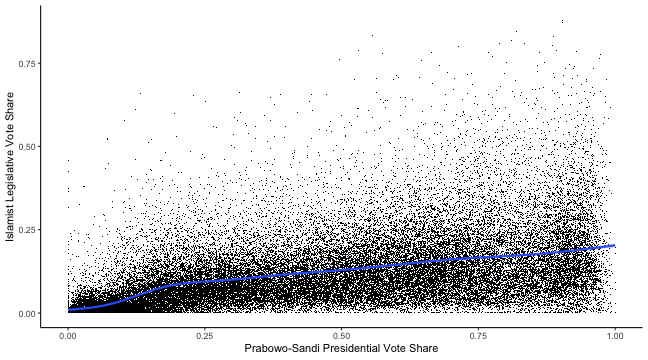
    One thing we can do is look at the aggregate vote share for Islamist parties at the village/ward level, and compare that to the presidential results. If Prabowo-Sandi earned more votes in villages where Islamist parties did well, then this is evidence—albeit indirect and circumstantial—that the effects of Islam on vote choice are more than just demographic in nature.

    And, in fact, this is what we find. Each tiny dot in the figure below is a village or a ward. And when we plot all 50,000+ of them, Prabowo-Sandi vote share versus Islamist party vote share, there is clearly a positive (if modest) correlation.
    plot of chunk islamist_share_village

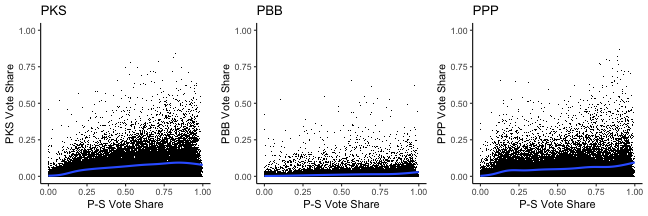
    Now, officially speaking, the Islamist politics here ought to be more complicated. After all, PPP joined Jokowi's coalition rather than Prabowo's. But contemporary Indonesia's partisan alignments are famously fluid, and it would not be surprising if voters who supported Islamists in the legislature also supported Prabowo-Sandi. We can check this by once again breaking down the results by Islamist party.

    plot of chunk islamist_share3

    That there is a positive relationship between PPP legislative vote share and Prabowo-Sandi results tells you just how strong these partisan coalitions are. For those curious, it's also possible to show these results in a regression format (controlling for turnout and 5000+ kecamatan fixed effects which wipe out most interesting differences across Indonesia's regions).

    ## 
    ## ============================================================================================================
    ##                                                              Dependent variable:                            
    ##                                  ---------------------------------------------------------------------------
    ##                                      islamist_share         ppp_share         pks_share        pbb_share    
    ##                                           (1)                  (2)               (3)              (4)       
    ## ------------------------------------------------------------------------------------------------------------
    ## ps_share                                0.158***            0.052***          0.097***          0.009***    
    ##                                         (0.006)              (0.004)           (0.004)          (0.001)     
    ##                                                                                                             
    ## leg_total                              0.00000***          -0.00000**        0.00000***        -0.00000*    
    ##                                        (0.00000)            (0.00000)         (0.00000)        (0.00000)    
    ##                                                                                                             
    ## ------------------------------------------------------------------------------------------------------------
    ## Observations                             54,278              54,278            54,278            54,278     
    ## R2                                       0.692                0.598             0.645            0.560      
    ## Adjusted R2                              0.660                0.556             0.608            0.514      
    ## Residual Std. Error (df = 49135)         0.061                0.042             0.044            0.017      
    ## ============================================================================================================
    ## Note:                                                                          *p<0.05; **p<0.01; ***p<0.001
    ##                                     OLS with kecamatan fixed effects, standard errors clustered by kecamatan
    

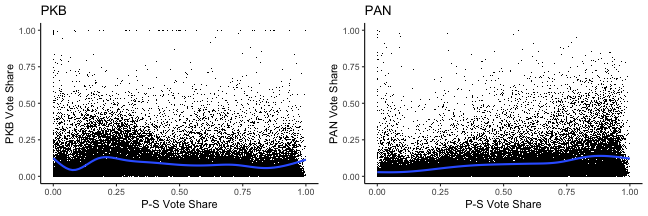
    The last link in this story are two parties that occupy an interesting position in Indonesian politics. PKB and PAN are both historically linked to important Muslim mass organizations (Nahdlatul Ulama and Muhammadiyah, respectively), but neither of them is Islamist. PKB joined Jokowi's electoral coalition—NU's leader Ma'ruf Amin served as Jokowi's running mate—but PAN joined Prabowo's coalition. How did that translate into partisan coattails at the legislative level?

    plot of chunk islamic_share

    PAN did better in places where Prabowo-Sandi performed better. But the same is not true for PKB. Its performance is uncorrelated with Prabowo-Sandi's performance. This is even true in a statistical test:

    ## 
    ## ===========================================================================================================
    ##                                                             Dependent variable:                            
    ##                                  --------------------------------------------------------------------------
    ##                                         islamist_share              pan_share              pkb_share       
    ##                                              (1)                       (2)                    (3)          
    ## -----------------------------------------------------------------------------------------------------------
    ## ps_share                                   0.158***                  0.114***                0.001         
    ##                                            (0.006)                   (0.006)                (0.005)        
    ##                                                                                                            
    ## leg_total                                 0.00000***                 0.00000               -0.00000**      
    ##                                           (0.00000)                 (0.00000)              (0.00000)       
    ##                                                                                                            
    ## -----------------------------------------------------------------------------------------------------------
    ## Observations                                54,278                    54,278                 54,278        
    ## R2                                          0.692                     0.657                  0.728         
    ## Adjusted R2                                 0.660                     0.621                  0.700         
    ## Residual Std. Error (df = 49135)            0.061                     0.063                  0.061         
    ## ===========================================================================================================
    ## Note:                                                                         *p<0.05; **p<0.01; ***p<0.001
    ##                                    OLS with kecamatan fixed effects, standard errors clustered by kecamatan
    

    With huge amounts of statistical power to detect a really small effect, we can confidently conclude that the coefficient on P-S in the third column is a precise zero.

    It's hard to know what exactly to conclude about ideology, identity, and partisan voting from this last set of results. But village-level demographic data will help to sort these findings out. Watch this space for more.