Category: Current Affairs

  • Impeachment and the Deepening of America’s Regime Cleavage

    President Trump has now been impeached, and the floor debate prior to the vote tells us something about the depths of America’s emerging regime cleavage. As I wrote in Politico several weeks back, this term refers to

    division within the population marked by conflict about the foundations of the governing system itself—in the American case, our constitutional democracy. In societies facing a regime cleavage, a growing number of citizens and officials believe that norms, institutions and laws may be ignored, subverted or replaced.

    Congressional floor debate in such circumstances, as every Congress specialist tweeted yesterday, are not actually a debates on the merits of the issue at hand. They are opportunities for Members of Congress to speak to their constituents. And what we heard in those debates, for those of you who had the stomach to listen to them (I did not), revealed that the GOP is now converging on a unified message that to even question the President’s actions is to threaten American democracy.

    Greg Sargeant wrote a nice column yesterday that illustrates how the impeachment proceedings have pushed the GOP towards and ever more cynical position on the illegitimacy of any Constitutional opposition to the president. Focusing on Kevin McCarthy statements about the House Democrats “defying the vote of your own constituents,” he suggested that for the GOP,

    the only voters that matter are the ones who voted for Trump in 2016 — those who elected the Democratic House don’t exist — and as such, Trump cannot be legitimately impeached simply by virtue of having been elected.

    This idiotic argument undermines itself — impeachment can only be directed at a president who was previously elected by definition — but it’s the actual position held by Trump and Republicans, who regularly call impeachment a “coup.”

    Trump cannot be legitimately impeached, and he is absolutely within his right to use the levers of government to corrupt the next election, to try and evade accountability at the hands of voters. And there is no legitimate mechanism to constrain him from continuing to do just that.

    I, like many who have been horrified by the debasement of the GOP and its utter dominance by President Trump, have long been cynical about the willingness of the GOP to rein in this administration’s corruption and abuse of power.

    But what we are witnessing is something worse, now: the message is that to remove the president is to attack democracy. Or, as evocatively put in a meme shared this morning on Facebook by a middle-school acquaintance who now lives in the great state of Florida,
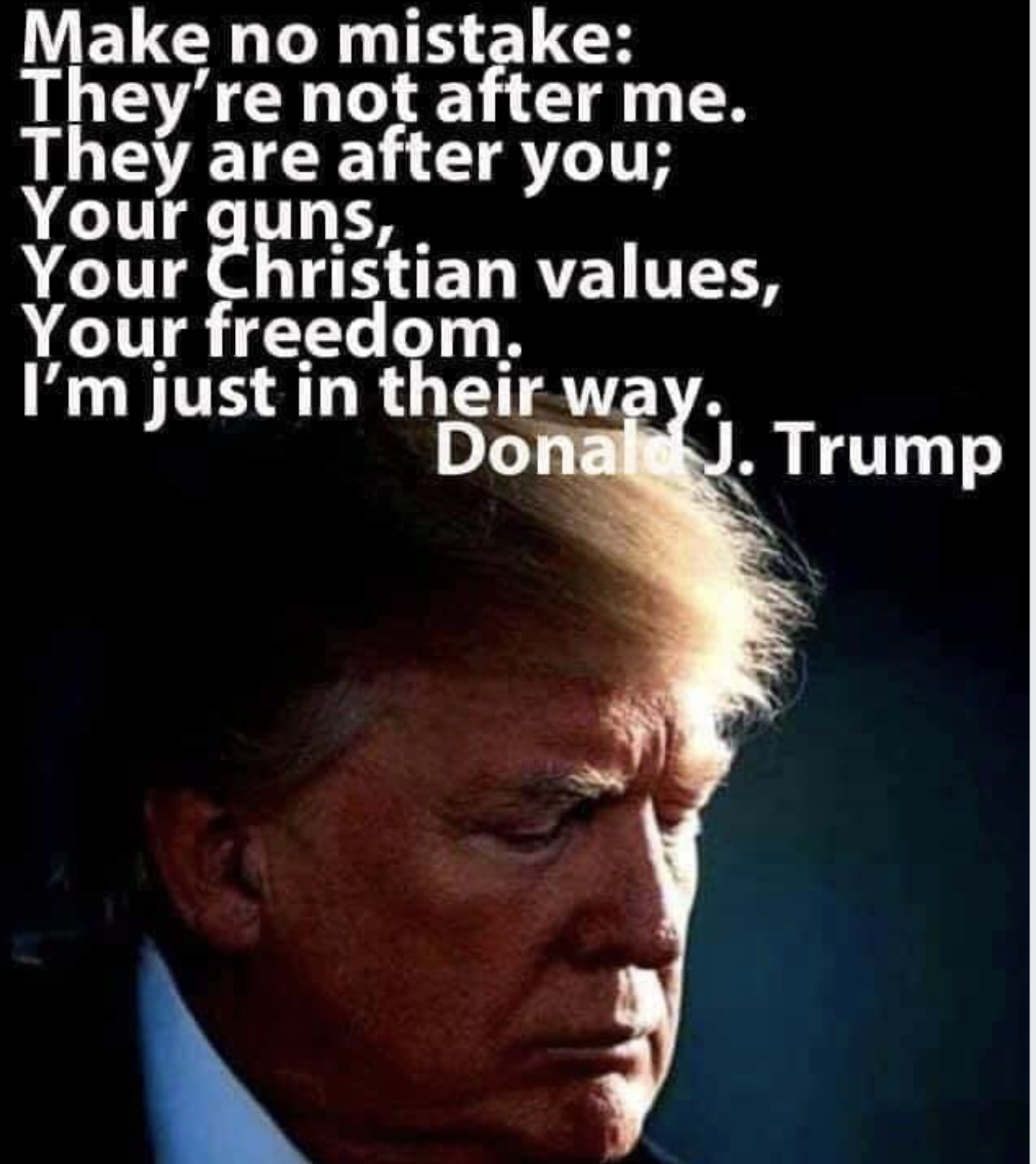
    As ridiculous as that message is, the strategy that it represents is worse. This is how political cleavages become regime cleavages.

  • Regime Cleavages and Democratic Imperfections

    I recently published a piece at Politico on America’s emerging regime cleavage. In comparative politics, a central concept in the study of democratic politics is the notion of a “cleavage structure,” which refers to the basic axis of political conflict within a society. Some countries have a class cleavage: upper versus lower class, bourgeoisie versus working class, and so forth. Others find themselves with an urban-rural cleavage: the cities versus the countryside, urban wage laborers versus peasants, or something similar. Still others have racial or religious or ethnic cleavages: Malays versus non-Malays in Malaysia, Protestants versus Catholics in much of Europe in the 16th through 20th centuries, whites versus non-whites in the United States and South Africa, etc. And yes, these dimensions often intersect in interesting ways: urban/rural non-Malay/Malay in Malaysia, white/nonwhite rural/urban blue collar/white collar in the United States.

    But democracy can survive—even thrive—with any of these kinds of cleavage structures just so long as the participants respect the institutions of democracy. Regime cleavages are different. Here, the axis of political conflict is about democracy itself. Those are not healthy conditions for the rule of law and the constitutional order, because one side favors democracy and the other side opposes it. Sure, it’s always the case that some individuals may oppose the rule of law or legal institutions because they don’t like them. But that’s not a regime cleavage. A regime cleavage emerges when for ordinary people, across society, the main political conflict is about democracy and its defense.

    That is, I argue, where the Trump presidency is leading American politics. And that is why the president needs to be impeached and removed, to show Americans that there is cross-partisan support for the American constitutional order. If not, and the president’s assault on the constitutional order metastasizes into a fully-formed regime cleavage,

    it will not be possible to elect a president who can “end the mess in Washington” because both sides of the regime cleavage will argue that the other is illegitimate and undemocratic. Voters, understandably, will lose what faith they have left in the value of democracy itself. In the worst-case scenario, presidents and their supporters would be entirely unaccountable to Congress, while their opponents would reject the legitimacy of the presidency altogether.

    But there’s one thing I didn’t touch on in that essay, which I want to address here. That is how to think about democracy in countries beset by deep, enduring cleavages that are not regime cleavages. Let me pose the question bluntly: what sort of democracy is it when, say, African Americans are unable to exercise their constitution rights in ways comparable to white Americans, because one (of not the) axis of political conflict is a racial cleavage?

    We all ought to agree that that is far from a perfect democracy. And we all ought to agree that questions of democratic legitimacy should be raised under such circumstances. For whom is democracy legitimate? And what does defending that kind of democracy imply about citizenship, political equality, and the so-called “common good”?

    Nevertheless, the striking observation is that those sorts of imperfect democracies do survive as imperfect democracies. They may survive because those excluded from full political participation are relatively powerless, disenchanted, demobilized, or actually detained, but they do survive just until that racial cleavage becomes a regime cleavage. One way to think about the Civil Rights movement, in fact, is as a strategy to create a regime cleavage out of a racial cleavage, to force the constitutional order to reckon with race rather than considering it just another deeply-felt political divide. In that case, the order evolved as a result, and the regime cleavage evaporated (even if the racial cleavage persisted).

    Those are the stakes for thinking about America’s emerging regime cleavage. Defending the regular constitutional order ought not be mistaken for defending some idealized version of American democracy. It should, however, be understood as defending a system that allows for those excluded from full equality to use the tools of American democracy to press for their interests without destroying those institutions along the way. That is an imperfect democracy worth defending.