
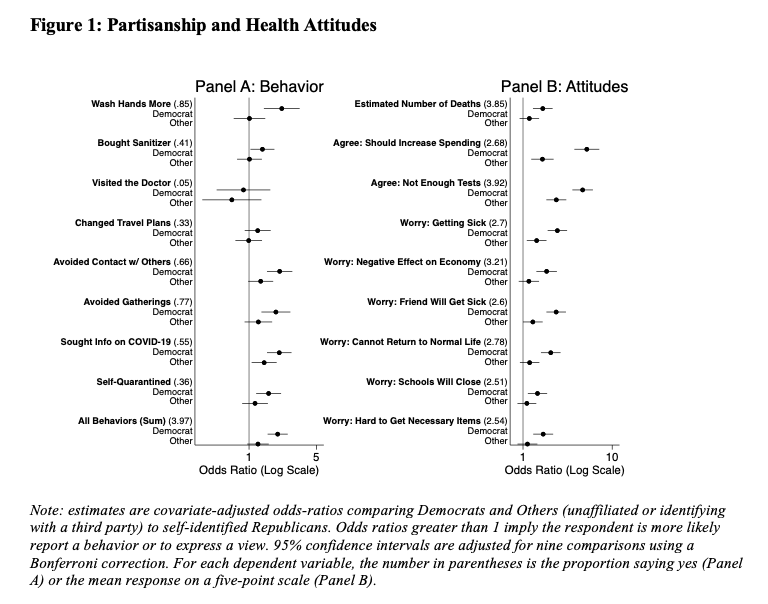
I recently shared some results on the partisan politics of COVID-19 from a new working paper on public health behaviors and attitudes in the early days of the COVID-19 pandemic.
A common question in response is to ask about how geography interacts with health behavior. COVID-19 cases are not randomly distributed across America, and neither is partisanship. These are plausibly related to both the urban/rural divide in American politics, as well as to big social and political differences across states.
Our argument, though, is that partisanship dominates everything. Here is a way to show this. I have combined data as of March 23 on COVID-19 cases by state (from here) and by county (from here) and matched it to our survey respondents’ ZIP codes. I then estimated a new type of statistical model—a multilevel logistic regression model—that includes individual demographics, ZIP-code level measures of how rural the respondent’s place of residence is, county-level COVID-19 diagnoses, and state-level COVID-19 diagnoses, along with state-level random effects to model unobserved differences across states, all as predictors. If we plot the odds-ratios combine Democrats to Republicans and case loads at natural breaks in the distribution of cases by state and county (with other predictors in the model but not plotted to avoid too many results), here’s what we get.

As it turns out, our results for partisanship never change. And also as it turns out, state-level diagnoses don’t seem to matter very much, whereas county-level diagnoses do seem to matter a bit. Once again, it seems that partisanship dominates. We also get very weak results in this framework for how rural the respondent’s ZIP code is.

There will be more to explore in the coming weeks; we suspect that partisan differences will decline over time and that geographic ones will become more important. But that’s just a hypothesis, and it’s one that we’ll have to test.
 Tom Pepinsky