
The slow decline of Twitter as the default medium for sharing written content has interesting implications for the world of blogging and others of long-form writing on the internet. From a personal perspective, it also comes at an interesting time in the evolution of this particular blog, which is nearing its 1000th blogpost (this is post #994).
I’ll have more to say later about writing a blog that began in August 2004, well before Twitter, Facebook, or anything like that even existed. Here, let me share some reflections about what it is like to write blogposts in a world where I am no longer thinking about the engagement that they might receive via Twitter.
Twitter has Changed
A lot of the commentary about the future of social media is about Elon Musk and what he has done to Twitter since purchasing it. I just don’t care very much about that. But there came a point in December 2022 where my Twitter was nothing but tweets about Elon, and that got boring enough that I stopped looking at it for awhile. This was roughly the same time that a large wave of academics publicly announced that they were quitting Twitter altogether because they opposed Musk’s leadership and management decisions.*
Four months later, I haven’t quit Twitter, but I’m not looking at it anymore. I’m sure there’s lots of good content there, and my friends occasionally text it to me. But I don’t feel any connection to the platform. It’s as foreign to me as is TikTok. I don’t miss regular engagement with Twitter at all.
I’m not alone in this, I suspect. Twitter is probably still good for sports, pop culture, and jokes, in the same way that TikTok and Instagram are good for those things too. And journalists seem to be all over Twitter still (even though American public broadcasters are starting to leave the platform). Altogether, engaging on Twitter is not central to the news in the way that it was even a year ago. It’s not close to the virtual public square anymore (if ever it was). There is nothing that I need to know that I can only learn via Twitter, or that I need to learn immediately via Twitter, at the cost of having to engage with a platform that isn’t very fun or interesting to me.
RSS Still Works
Some people are eager replace Twitter with something else, which explains the rise of Mastodon. I have a Mastodon account, but it’s pretty dormant. Rather than replacing Twitter with some other equivalent, I am replacing Twitter with nothing really.

It would be nice to say that with all of my free time I’m getting into home improvements, sewing, relearning to play the trumpet, woodworking, or some other constructive hobby. But I’m just reading differently. Instead of reading tweets and linked content, I’m reading long internet essays. You can find those on Substack, but you can also find them on web logs (“blogs”) like this one.
How do I find these essays? Through the handy RSS feed that remains cooked into the fabric of the internet, which allows me to use an RSS aggregator like Feedly to neatly follow a whole bunch of writers who publish long essays at irregular intervals. I can follow WordPress blogs like this one, Substacks, hand-coded blogs, lots of things. It turns out that I like to read philosophy, linguistics, statistics, and Asian studies blogs.
And there is also a growing list of people who just post once in awhile who I like to read too; this community would have had a Typepad or WordPress blog back in the day, but if they’re starting now it’s probably Substack or GitHub. This group of authors is way, way more politically diverse than my Twitter feed ever was. It is also completely free of culture war argle-bargle—quite the contrast with my Twitter feed.
The point is, there is content out there for me, and I don’t have to manually search for it, nor do I have to remember each source because Feedly remembers it for me. I probably encountered most of this content via Twitter in The Before Times. The difference now is that I’m not relying on people I follow to find things for me and tweet them, nor am I relying on an algorithm to supply me with suggestions based on my behavior and the behavior of other people like me. I have a list of authors that I want to read, and RSS shows me just what they write, all of what they write, and nothing else.**
Those of you of a certain age are probably smiling a little bit at the very idea of explaining RSS on a blog in 2023. Yes, probably everyone know about this, but it’s good to refresh our memories every once in awhile, to remember that long-form internet content is fun, abundant, and with very minimal effort you can set yourself up to read it whenever you like.
I’m Not Optimized and That’s OK
The basic premise behind all social media is that they are platforms that “optimize user experience.” What this means, generally, is that they encourage you to look at the platform. The point of the platform is to be on the platform. When being on the platform become uninteresting, people move on; knowing this, the platform tries to show you things that are interesting to you so that you stay engaged with the platform. Platform platform platform.
The “blogosphere” and its sibling, the “newsletter-osphere,” work differently. The service providing the content is less important than the content itself. This means that you generate interest for the blog by creating content that people want to read. And there is no reason to confine the user to the blog or the newsletter; you can read it and move on, sharing as necessary via whatever technology allows you to show other people things that you found on the internet.
This means that I’m missing lots of content because I’m not having it pumped straight into my veins anymore by a platform. Probably lots of good content! But the interesting thing about returning to the world of RSS feeds is that it feels a lot more like the internet of the mid-2000s, a time during which my internet experience was not optimized but I also read a ton of interesting things anyway. In 2023, I’m not optimized for clicks anymore, but it feels sufficient for thoughts.
Of course, WordPress and Substack and various alternatives are wannabe platforms too. WordPress would love to show me its network of recommended content that are also on its service; so would Substack. But they are not attempting to be my “portal to the internet,” nor is it possible to imagine any of them becoming the central place where one goes to access long-form writing.
At least, not right now and not as currently configured. Substack seems to be pushing itself into the direction of a one-stop shop for The Discourse, through the Substack Notes function.*** But it’s still not optimized for dopamine hits as currently configured, which makes it different for both readers and for writers.
A Non-Optimized Writer for a Non-Optimized Audience
And now, at long last, we are at the point of this post. I’m only a little bit interested in talking about how Tom Pepinsky consumes internet content in the twilight of Twitter, except for as a demonstration case. I am more interested in what this changing ecosystem of social media content does to writers.
I’ve written some stuff over the years on the blog that people (apparently) have read. Viewed from the perspective of a blog that would be old enough to vote if it were a person, it was only relatively recently that I even had a mechanism to pay attention to who had read my posts or what they thought about them. That is what Google Reader (RIP)**** provided, and eventually also Facebook and then Twitter.
That’s right, until about 2012 I just wrote on this blog and then people told me about it later if they read it and liked it (or not). That was fine. This is fine.
Writing changes when you know that random people will read what you’ve written. It also changes when you have a system to discover what randoms think about it, especially when that system is optimized for dopamine hits, dunks, and breezy misreads and misquotes. My writing got better when I started anticipating how my corner of the online world would engage with it… and it also got a lot safer when I realized that Twitter would be the way that people discovered it, including mostly random people who are not interested in a conversation.
Writing on blogs feels a lot more exciting and interesting in the twilight of Twitter. I don’t know who, if anyone, will read this! But I’m not optimizing for random strangers anymore, now I’m optimizing for strangers who are reading this because they want to. That might be only a handful of people, but I’m not trying to make a career as a blogger so I don’t mind.
Because I’m not alone in this, there are obvious network effects too, and those are starting to kick in. It’s a great time for long-form writing on the internet again, it hasn’t been this exciting in a solid decade.
So, although I cannot predict the future, if you gave me $100 to spread around bets about the future of social media over the next 6 months, I would put that mostly on blogs and bloglike things like newsletters. People are out there making content as they always have, but now they are doing so with the understanding that they have to get noticed across platforms. What a time to be alive.
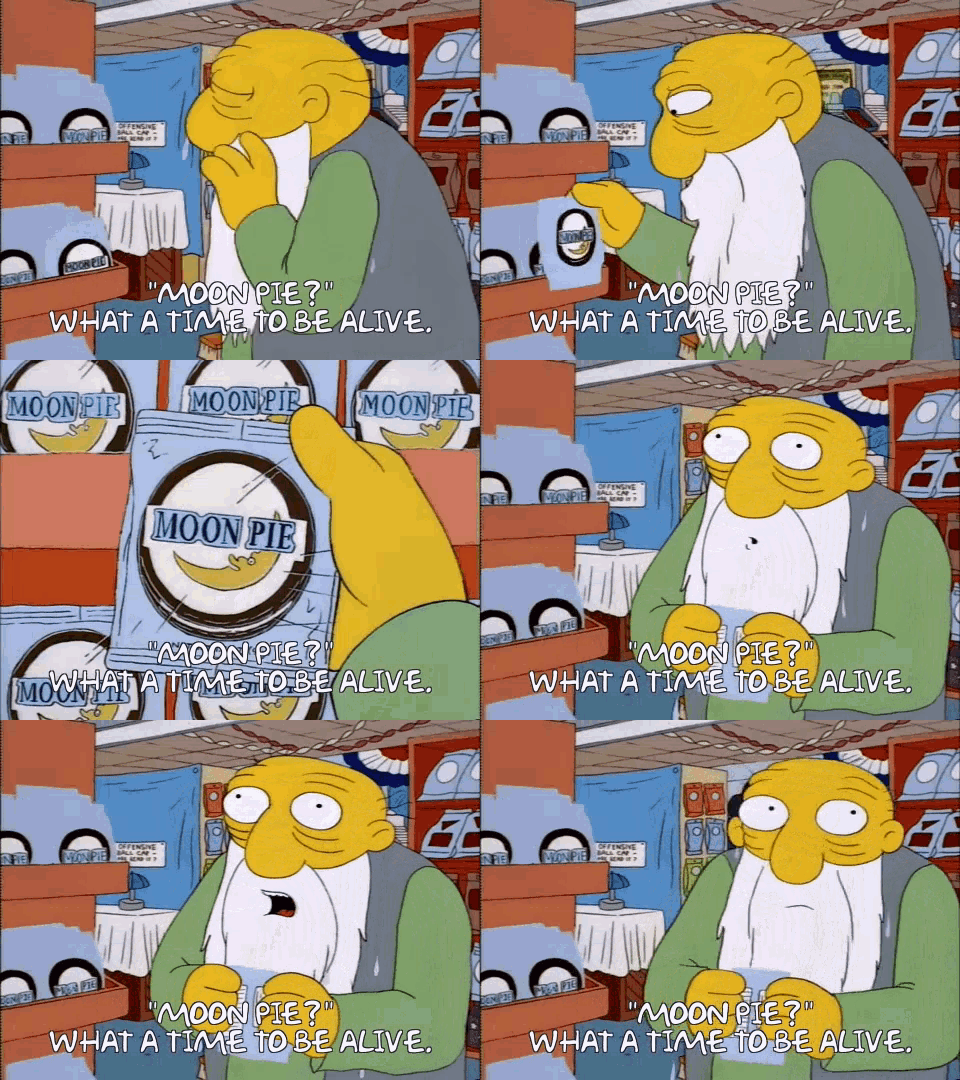
Let’s hope it lasts. Knowing the power of money to motivate and compensate our tech oligarchs, and their indifference to social causes, it probably won’t.
NOTES
* Academics are a tiny portion of the Twitter community, but they are particularly noisy and many had close relationships with certain journalistic types, so their influence was (is? dunno) rather disproportionately large relative to their numbers.
** I am aware that Feedly is trying to sell information about my reading habits, and that it is also training some sort of AI to infer meaning from texts. But so long as it is an RSS feed, it is fine by me. And if Feedly stops being that, I replace it with something else.
*** And Chris Best completely gave up the game while also looking like a fucking idiot.
**** Bloggers of my age cohort are required to talk about how terrible it was when Google killed Reader. Blah blah I agree, but I’m not sure that everyone understands that it is entirely consistent with the data to observe that the end of Google Reader is associated with the disintegration of American politics. I’m not sure Google caused democratic backsliding in America, but they certainly Granger-caused it. (This is a joke.)
 Tom Pepinsky