
As I polish up a first serious draft of a paper on decolonization, today I came across a discussion of “annexation.” I invite readers to peruse the following and imagine which tropical territory is being discussed.
Many…who felt…that annexation was inevitable sentimentally opposed it. It would be far pleasanter, were the world constituted differently, for many states, representing different planes of culture, different races, and differing attitudes toward life to exist beside one another in amity. But the world, simply, was not constituted that way.
In the Nineteenth Century, as always before and always after, it was a realistic world, one whose separate parts continually came closer together. _____, potentially, had things that the world wanted. Left untroubled, the _____ans themselves clearly would not produce those things. Yet it could be fairly argued that they had no right to fail to do so. No one of radical opinions would grant the right of a private owner of great acres, of a factory, of a ‘means of production’ of any kind, to shut it off from common use merely because it was the owner’s whim or nature to do so. How then could it be argued that far greater proprietors under the name of race or nationality should exercise that right?
Seems like something right out of the “enlightened” part of the colonial era, right? Say, mid-19th century on. Probably some Belgians talking about rubber in the Congo Free State. Or the British talking about rice in the Irrawaddy delta. The sentiment is not so much that the European should be enslaving the colonial subject, but rather that the colonial subject cannot be a proper member of the global economy without some direction. What is an enlightened European to do? (I love the use of the construction “it could be fairly argued” here.)
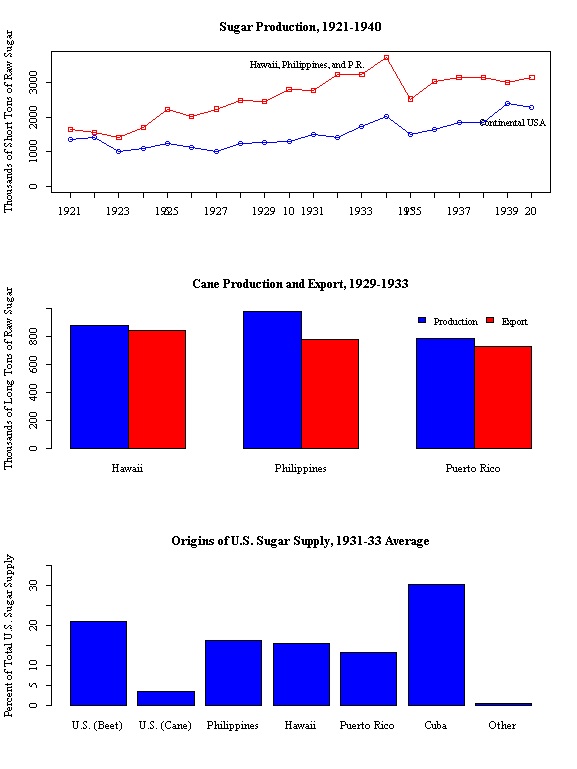
Turns out, this quote is of more recent vintage, and it is not European. It is taken from John W. Vandercook’s 1939 book King Cane: The Story of Sugar in Hawaii (New York: Harper & Brothers Publishers), pp. 42-43. Yes, this is a quote is referring to the annexation of Hawaii, so that those noble yet indolent Hawaiians could be directed to grow sugar.
Americans owe it to themselves not to forget this chapter of our history. For more, I highly recommend McCoy and Scarano’s Colonial Crucible on the role of empire in the construction of the modern American state.
 Tom Pepinsky