
The coverage of Singapore under the late Lee Kuan Yew consistently emphasizes a theme of rapid economic development in an inauspicious context, encapsulated by the slogan “From Third World to First.” See e.g. here and here. This goes back to a book with the same name from 2000.
Now, no one should doubt that Lee Kuan Yew was a developmentalist statebuilder par excellence. But Singapore at independence a third-world country? This narrative neglects the incredible legacy of openness, infrastructure, and stability that the British rule left this tiny country.
The graph below says it all. For every year since 1945, I have ranked all independent countries by real per capita GDP, the best measure we have of economic prosperity. I then normalize these to a percentile scale. Here is what we get.
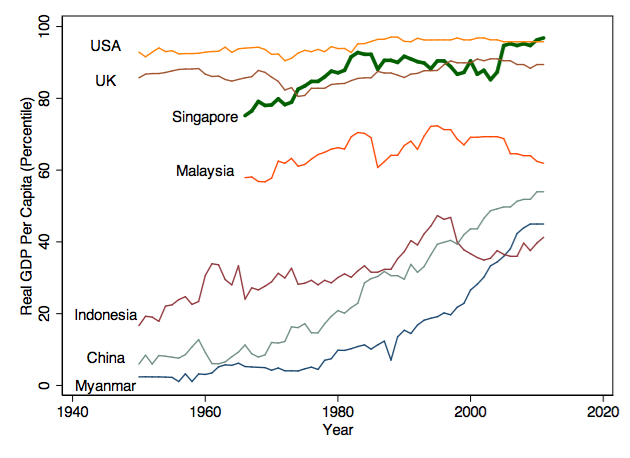
Yes, you have that right: already by the 1970s, Singaporean GDP per capita actually exceeded that of the UK. But the main point to take away from that graph is that Singapore entered the community of independent states as a prosperous country, at least by the standards of the time. That Singapore has progressed tremendously since independence is true, but not a story of turning the “Third World” into the first. If anything, it is a story of how to escape the middle income trap.
The comparison with Malaysia is particularly evocative, recalling that Singapore and Malaysia were the same country until 1965. A quick inspection shows that while the two countries differed in their base level of economic prosperity, relative growth trajectories in the two countries were basically parallel until the mid-2000s, when Malaysia began to decline and Singapore really took off.
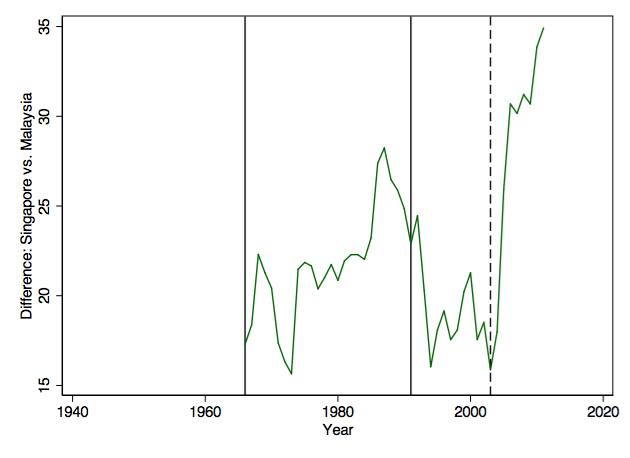
The black lines are Lee Kuan Yew’s term as Prime Minister in Singapore. The dashed line in Malaysia? That’s when Mahathir Mohamad retired.
UPDATE: Interested readers who want to see the data should check out this comment, where I explain where the data come from and how I created the figure.
 Tom Pepinsky