The first principle of Southeast Asian studies is the very artificiality of the concept of Southeast Asia. I have called this the “fundamental anxiety” of Southeast Asian studies, that there is no coherent argument why Southeast Asia properly includes Burma but not Bangladesh or Sri Lanka, or why it includes Indonesia but not Papua New Guinea, why Vietnam ought to fall within Southeast Asia rather than East Asia.
And yet Southeast Asia does exist. It is now a social fact. For example, Google knows exactly what Southeast Asia is and what it is is not.

Southeast Asian studies programs cover the same set of countries in the US, in Southeast Asia itself, in Japan, and elsewhere. The Association of Southeast Asian Nations will someday include Timor-Leste, and will never include Sri Lanka, Taiwan, or the Solomon Islands. Southeast Asianists have for decades lamented the intellectual strictures that Southeast Asian-ist thinking can place on their scholarly inquiry, and there is a rich genre of border-crossing Southeast Asian studies—on Zomia, most famously, but there are many others—that conceptualizes some subset of the peoples of the region as part of some competing configuration of peoples or states. Yet such inquiry has failed to dismantle the concept of Southeast Asia entirely, and my prediction is that it never will. Just look at how the Association for Asian Studies imagines Asia.
In my view, the durability of Southeast Asia as a social fact is easy to explain. The much more interesting question is, how did we get here? How did Southeast Asia become a social fact, and how did it become this particular social fact? Those eleven states, no more and no less?
The customary answer is that the concept of Southeast Asia is an external projection of Western images of the East onto the people living there. In some basic sense this is certainly true, but it leaves the details underspecified: why did the West happen to think that Vietnam is part of Southeast Asia, but not Bangladesh? Culturalist and geographic answers to such questions do not withstand close scrutiny; the Wallace line excludes the Philippines and half of Indonesia, for example, and Theravada Buddhist cultural influences are minor in much of Indonesia, the Philippines, and Vietnam. The answer upon which most scholars seem to settle is due to Ruth McVey, who looked to the idea of Southeast Asia as a lineage of the Second World War. This explains both timing and content of Southeast Asia, through
the coincidence between Southeast Asia’s birth as a concept and the triumph of American world power. World War II was important not for the bureaucratic detail of the South East Asia Command but for the fact that the Japanese occupied the region, creating an abrupt break with the era of European domination and making it an object of American attention.
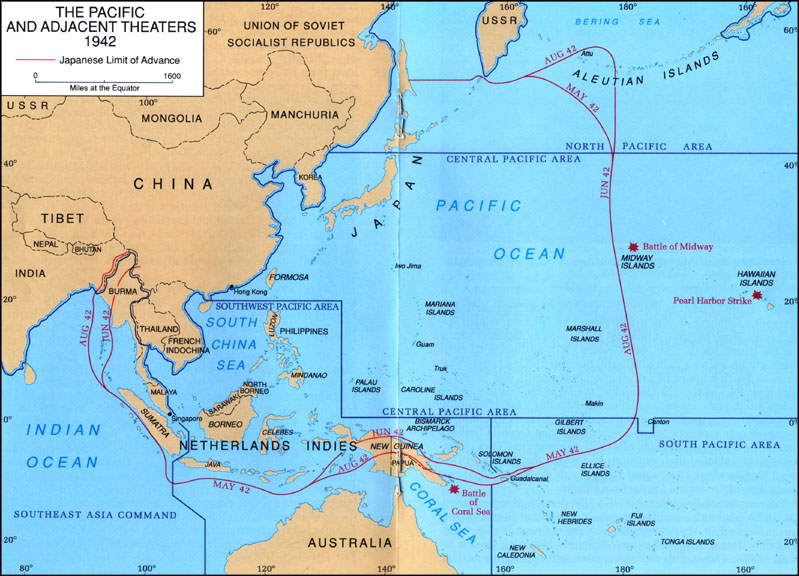
McVey’s insightful analysis forms the core of my own understanding of why Southeast Asia is what it is. But the argument is incomplete because the South East Asia Command does not coincide with the social fact of Southeast Asia. Here are maps of Southeast Asia in the eyes of the Allied military command structure in 1942 and 1944.


Never were the Philippines and most of Indonesia part of the South East Asia Command. The South East Asia Command, in fact, operated out of Sri Lanka. And never was it the case that Japanese occupation demarcates the boundaries of contemporary Southeast Asia, even to a first approximation.
I am left without a good explanation for how Southeast Asia came to be this particular social fact. I wonder if readers can point me to other answers, no matter how grandiose or mundane they may be. It could be, for example, that Southeast Asia emerged as a social fact in response to the crystallization of other social facts, of South Asia, of China as including both the mainland and Taiwan, of Australia as a Western country, and of Melanesia and Micronesia as separate regions. Such an argument would raise other questions, but those questions too could help reveal why Southeast Asia is what it is.


 Tom Pepinsky